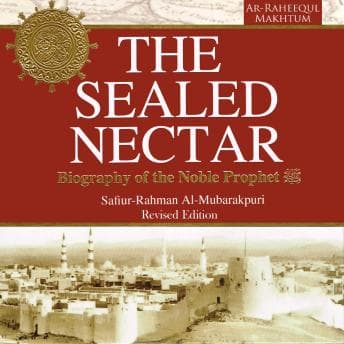

How do you even approach reviewing a book about the Prophet Muhammad (peace be upon him) when you're a lapsed Catholic Mexican-American girl who grew up lighting veladoras with her abuela? You approach it with respect, with curiosity, and with the same openness your grandmother taught you when she'd say, "Mija, God is bigger than any one church."
I picked up The Sealed Nectar during a week where I was deep in a branding project for a halal food company, and I wanted to understand more - not surface-level Wikipedia stuff, but the real, detailed biography. Twenty-three and a half hours later, I'm a different listener than when I started. Not converted, but genuinely moved. And yeah, I cried. Twice. Which I did not expect.
This Is Not a Casual Listen - And That's the Point
Let me be honest: this book is dense. Like, scholarly dense. Al-Mubarkpuri wrote this for the Muslim World League competition and won first prize, and you can feel that academic rigor in every chapter. There are genealogies, tribal alliances, battle formations, and passages from the Quran woven throughout. If you're expecting a breezy narrative biography like, say, a celebrity memoir, recalibrate. This is closer to a textbook that happens to be about one of the most influential humans who ever lived. The Neal Gabler biography Walt Disney: The Triumph of the American Imagination has that same textbook-meets-biography energy - dense, meticulously researched, and somehow still emotionally alive underneath all the apparatus.
But here's what got me - underneath all that structure, there's a deeply human story. The passages about the Prophet's early life, losing his mother Aminah when he was just six years old, then his grandfather Abd al-Muttalib two years later? My heart. MY HEART. I was resizing a logo and had to stop because I was sitting there with tears running down my face thinking about my own abuela, about what it means to lose the person who anchors you to the world. That grief is universal. It doesn't care what language you pray in.
The second time I cried was during the description of the Hijrah - the migration to Medina - and the moment of Abu Bakr weeping in the cave. There's something about loyalty under pressure, about someone choosing to stay with you when staying could cost them everything. That hit me in a very specific place I wasn't guarding.
Bilal Abdul Kareem Behind the Mic
Okay, so the narration. I want to be fair here because this is a 23-hour commitment and the narrator matters enormously at that length. Bilal Abdul Kareem has a clear, steady voice with genuine reverence for the material. You can tell this isn't just a gig for him - he believes in what he's reading, and that sincerity carries weight. His pronunciation of Arabic names and terms feels natural and confident, which matters a lot in a text this loaded with them.
But - and I say this gently - it's pretty much one register the whole way through. There's not a lot of dynamic range between the battle sequences and the quieter, more intimate moments. When you're listening for 23 hours, that evenness can start to feel flat, especially during the long sections on tribal politics and military strategy. I found myself zoning out during some of the later ghazwat (expeditions) descriptions, not because the content wasn't important, but because the delivery didn't shift gears to signal "hey, this part is different." Julia Whelan would've given me seven distinct emotional textures in that same stretch. But that's an unfair comparison, and I know it.
I ended up listening in 2-3 hour blocks during late-night design sessions, which actually worked well. The steady pace kept me focused without pulling me out of my workflow during less emotionally charged sections.
Who Should Press Play (And Who Shouldn't)
If you're Muslim and want a comprehensive, award-winning seerah in audio form, this is probably already on your list and it should be. It's thorough, respectful, and scholarly in the best sense.
If you're not Muslim but you're genuinely curious about Islamic history and the life of the Prophet - like I was - this is an incredible resource, but know what you're signing up for. It's long, it's detailed, and it assumes some baseline familiarity with Arabian geography and tribal structures. I had to Google things. Multiple times. That's not a flaw in the book; it's just the nature of the subject.
If you need narrative momentum and character-driven storytelling to stay engaged with biography, this might be a tough listen. The structure is more chronological-historical than dramatic-narrative.
Abuela Would've Had Questions (But She Would've Listened)
This book felt like sitting in a university lecture given by someone who loves their subject so much they forgot to check the clock. It's not always easy. It's not always emotionally accessible. But when it hits - when the humanity of the Prophet breaks through the academic framework - it hits hard. I'm glad I listened at 1.0x. I'm glad I gave it the full 23 hours. Some books you savor not because they're sweet but because they're substantial, and this is one of those.
Abuela would have had a million questions. She would've compared everything to her Bible stories. She would've found the parallels fascinating and the differences confusing. And she would've respected it, because she respected anyone who took their faith seriously. Miss you, Abuela. You would've loved arguing about this one.








![Steve Jobs [unabridged audiobook] audiobook cover](/_next/image?url=https%3A%2F%2Fcovers.audiobooks.com%2Fimages%2Fcovers%2Ffull%2F9788499923406.jpg&w=1920&q=75)