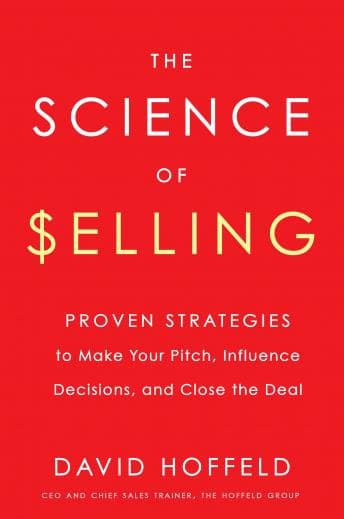

Look, I need to rant about something. David Hoffeld wrote a genuinely excellent sales book backed by real neuroscience and behavioral economics research - and then he narrated it himself in a delivery so flat it could be used as a calibration tool for audio levels. This is the audiobook equivalent of a brilliant engineer giving a conference talk while reading directly from their slides. I know because I've been that engineer.
I started this one on a Tuesday morning commute, 6:12 AM Caltrain, and I kid you not - I dozed off before we hit Millbrae. Not because the content is boring. Because Hoffeld's narration is basically a white noise machine wearing a business suit.
The Content Is a 5-Star GitHub Repo With Zero Documentation
Here's what's frustrating: the actual substance is genuinely good. Hoffeld doesn't just tell you "build rapport" like every other sales book that could've been a blog post. He cites specific studies - like the research on how asking buyers to rate their commitment on a 1-10 scale creates what he calls "micro-commitments" that neurologically prime them toward a yes. Or how the brain processes objections differently when they're reframed as questions versus statements, drawing on dual-process theory from Kahneman's work.
The six "whys" framework is probably the most useful thing I've pulled from a business audiobook this year. Hoffeld argues that every buying decision requires six sequential mental commitments - why change, why now, why your industry, why your company, why your product, why spend the money - and that most salespeople skip straight to product features without laying the neural groundwork. As someone who's had to "sell" engineering proposals to leadership, this framework actually clicked for me in a way that Challenger Sale never did. The research-backed approach is a welcome change from the hustle-bro noise I had to sit through in TenX Rule, which clocked in at a similar rating but leaned way harder on Grant Cardone's personal mythology than on any actual science.
He backs nearly every claim with published research. Social psychology studies on emotional priming, neuroscience on how dopamine affects decision-making during purchasing, behavioral economics on loss aversion in negotiation contexts. The ROI on this audiobook is legitimately high if you work in any role where you need to persuade humans to do things (so... all of them).
But the Narration Is a Production Incident
And now we get to the problem. Hoffeld narrates his own book, and it's - I'm trying to be kind here - monotone. Not "calm and measured" monotone. More like "reading a technical spec aloud at 70% engagement" monotone. There's no vocal variation between his anecdotes and his data citations. The pacing stays at one speed regardless of whether he's describing a breakthrough study or transitioning between chapters.
I fell asleep to this book three separate times. Three! And I'm someone who regularly listens to dense sci-fi at 1.5x without losing the thread. I had to bump this up to 1.75x just to keep my brain engaged enough to absorb the content, and even then certain stretches around hours 4-5 felt like they were actively fighting my consciousness.
(Kevin asked why I kept rewinding the same audiobook and I told him it was "spaced repetition for retention" because I wasn't about to admit I kept passing out on the train.)
A professional narrator - honestly even someone mid-tier, doesn't need to be Ray Porter - would elevate this book from a grudging recommendation to a must-listen. The fact that it's author-narrated when the content deserves so much better genuinely bothers me. It's like shipping a beautiful API with no error handling.
Who This Is Actually For (and Who Should Grab the Kindle Instead)
If you're in sales, business development, or any persuasion-heavy role and you can handle dry delivery, this is worth powering through. The frameworks are practical and actually backed by real research, not just "I closed a million-dollar deal and here's my anecdote" energy. If you're an engineer or PM who needs to sell ideas internally - yeah, this is surprisingly applicable.
But if you're looking for something to keep you alert during a commute? Get the print or ebook version. I'm dead serious. The content is too good to miss, but the audio format actively works against it. This is one of the rare cases where I'd say the audiobook is the worst way to consume great material.
Perfect for: focused desk listening at 1.75x. Skip for: commute, gym, anything where you need engagement to stay awake.
The Commit Log
Five-star content trapped in a two-star delivery. I'm giving it a 3.5 because the substance genuinely earns it, but I want you to go in with eyes open (and maybe an espresso in hand). If they ever re-record this with a professional narrator, bump my rating to a 4.5 and buy it immediately.









