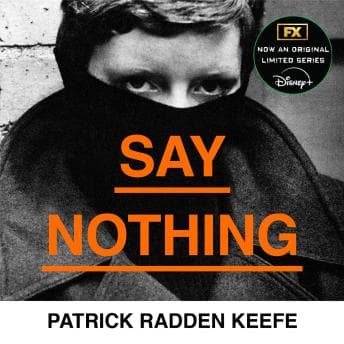

"Whatever you say, say nothing." That line hit me around hour three, driving back from a client site in Houston. Had to pull over at a rest stop. Not because I needed gas—because I needed a minute.
Let me cut to the chase: This is one of the finest pieces of investigative journalism I've encountered in audio form. Keefe does something I've rarely seen done this well—he takes a single murder, Jean McConville's abduction in 1972, and uses it as the lens through which you understand an entire conflict. It's the kind of structural discipline that would make any intelligence analyst jealous.
The Weight of Silence
I've been to places where people don't talk. Where asking the wrong question gets you killed, or worse, gets someone else killed. Keefe captures that suffocating atmosphere of Belfast during the Troubles with precision that made my skin crawl.
The Price sisters' story—Dolours and Marian, barely out of their teens, bombing the Old Bailey, then enduring forced feedings during hunger strikes—that's the kind of fanaticism you read about in after-action reports. Except here, you understand how they got there. You see the path. Sergeant York and His People does something similar with its subject—shows you the before, the circumstances, the slow transformation that turns a person into something history remembers but rarely understands.
Matt Blaney's narration is... look, it's not flashy. His Irish accent is authentic, lending the whole thing credibility that a generic American voice never could've achieved. But he keeps it measured, almost documentary-style. Some folks might find it monotonous over nearly fifteen hours. I didn't. When you're dealing with content this heavy—mothers being dragged from their children, bodies buried in unmarked graves, the systematic brutality on all sides—you don't need theatrical delivery. You need a steady hand. Blaney provides that.
When Former Allies Turn Witness
The dynamic between Brendan Hughes and Gerry Adams is where this book really grabbed me by the throat. Hughes, the fearsome IRA commander who eventually broke the organization's code of silence. Adams, who helped negotiate peace but continues denying his IRA involvement despite overwhelming evidence. I've seen this scenario play out in real life—the true believers versus the politicians, the ones who did the wet work versus the ones who learned to speak in press conferences.
Keefe clearly did his homework. The Boston College oral history project, the archival research, the interviews with people who had every reason to stay quiet—it's meticulous without being dry. He weaves between timelines like a skilled interrogator, always circling back to Jean McConville and her ten children, orphaned and scattered, waiting decades to learn where their mother's body was buried.
(Ranger perked up during the section about the disappeared—I think he sensed my tension. Dogs know.)
The Uncomfortable Questions
Here's where some listeners take issue: Keefe focuses heavily on Republican violence. The Loyalist paramilitaries, the British Army's own atrocities—they're present but not centered. Is that a flaw? Depends on what you think the book is trying to do. This isn't a comprehensive history of the Troubles. It's an investigation into one murder and the people connected to it. The IRA killed Jean McConville. That's where the trail leads.
The density is real, though. Names, dates, operations, political factions—at 1.25x speed, I still occasionally had to rewind. This is not background listening. Don't put this on while doing anything else. You'll miss crucial connections and spend twenty minutes confused about who's who.
Mission Assessment
Worth your time? Here's the debrief: If you have any interest in how ordinary people become capable of extraordinary violence—and how societies attempt to reconcile after decades of bloodshed—this is essential listening. If you want to understand why peace processes are so fragile, why some wounds never heal, why "moving on" is a luxury not everyone can afford—Keefe delivers.
Skip it if you need action-heavy pacing or can't handle dense historical content. Skip it if you're looking for easy answers about good guys and bad guys. The Troubles didn't have those, and Keefe doesn't pretend otherwise.
Fourteen hours and forty-three minutes. That's a significant commitment. I've spent longer in briefings that taught me less about human nature. The McConville children finally got their mother's remains in 2003—thirty-one years after she was taken. Some of her killers attended her funeral. Think about that.
Ranger approved this one. So do I.






![Steve Jobs [unabridged audiobook] audiobook cover](/_next/image?url=https%3A%2F%2Fcovers.audiobooks.com%2Fimages%2Fcovers%2Ffull%2F9788499923406.jpg&w=1920&q=75)