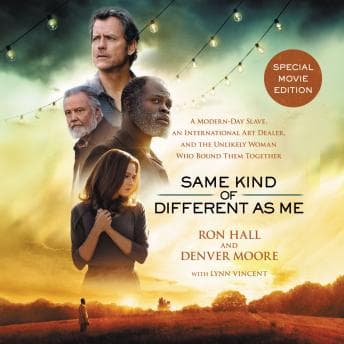

There's a line in this book that stopped me dead in my tracks while I was loading the dishwasher. Denver says, "I used to be a nobody. Now I'm a somebody. I used to pick cotton. Now I pick friends."
(Okay, I might be paraphrasing slightly because my hands were covered in soap suds and I couldn't hit the rewind button fast enough, but the sentiment? It stuck.)
I went into Same Kind of Different As Me expecting one of those saccharine, made-for-TV inspirational stories. You know the kind—where the music swells and everyone learns a valuable lesson in forty-five minutes. And yes, I know there's literally a movie version of this. My mom has probably watched it six times. But the audiobook? It's a different beast entirely.
Two Narrators, Two Worlds
Here's the thing about dual narration: usually, it's a gimmick. One narrator is clearly better, and you spend half the book waiting for the "good" chapters. Not here.
Barry Scott (reading for Denver) and Daniel Butler (reading for Ron) aren't just reading; they're inhabiting these guys. Scott's voice is like gravel rolling around in a cement mixer. Deep. Full of weight. It carries the history of a man who grew up sharecropping in Louisiana—basically modern-day slavery—in the 1960s. When he speaks, you listen. (I listened at 1.0x speed, obviously, because rushing through that kind of dialect would be a crime against literature.)
Then you have Butler as Ron, the high-flying art dealer. He's crisp, articulate, a little bit frantic. The contrast between them is jarring in the best way. It forces you to hear the socioeconomic divide before the text even explains it. As an English teacher, I'm constantly telling my students that "voice" is more than just word choice. This audiobook is Exhibit A.
When It Gets Real (And Gritty)
I'll be honest—I expected the "religion" tag to mean the book would shy away from the ugly stuff. It doesn't. The descriptions of Denver's early life are brutal. We're talking about a man who was effectively enslaved decades after the Emancipation Proclamation. Heavy stuff. Steinbeck would've had a field day with this material.
There were moments walking along Lake Michigan where I had to just stop and stare at the water because the injustice described was so visceral. It makes the later redemption arc actually feel earned, rather than just slapped on for a happy ending.
That said, the middle section does slow down a bit. There's a lot of spiritual dialogue that might feel repetitive if you aren't the target demographic for Christian literature. (I zoned out once or twice during a long theological exchange and realized I'd walked three blocks past my house. Denise was not amused when I finally got back.)
The Movie Edition Extras
Usually, "Bonus Material" is code for "stuff the editor cut for a reason." But since this is the Movie Edition, you get some background on the film production in Jackson, Mississippi. It's interesting enough, mostly because it shows how weirdly meta the whole experience became for the authors. Do you need it? Maybe not. But it's a nice cooldown lap after the emotional marathon of the main story.
Who's This For?
If you appreciate faith-based narratives that don't flinch from hard truths, or if you want to hear what genuinely great dual narration sounds like, this one's worth your time. Skip it if extended theological conversations make you antsy—the middle section will test your patience.
The Bell Just Rang
Look, is this high literature in the Faulkner sense? No. But is it effective storytelling? Absolutely. It's a story about how messy human connection actually is. Not clean. Awkward and painful and requiring a stubborn kind of love.
That messiness is something I appreciated in Torment too, though in a completely different context—relationships there are just as complicated, just less redemptive.
My students would probably roll their eyes at the title, but if I played them five minutes of Barry Scott's narration, I bet half of them would take their AirPods out. And that's saying something.