
So last Tuesday I'm sitting in the dentist's waiting room - Kevin's getting a crown replaced - and I've got 45 minutes to kill. I'd been putting off this one because, look, sales books and I have a complicated relationship. I'm a software engineer. My "sales" pitch is convincing my tech lead that my refactoring PR won't break prod. But I keep hearing Gitomer's name thrown around in those optimization podcasts I'm definitely not addicted to, and at 8 hours, it's a pretty low-commitment listen. So I hit play.
Four commutes later, here we are.
Could've Been a Blog Post? Actually, No.
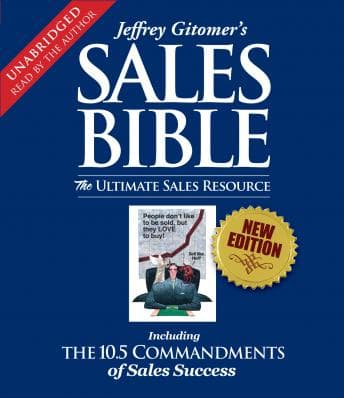
This is where I eat my words a little. I went in fully expecting the usual business book bloat - you know the formula: one good idea, three anecdotes, seven chapters of filler, repeat until 12 hours are up. The Sales Bible doesn't really do that. Gitomer structures this thing more like a reference manual than a narrative. Short, punchy sections. Rapid-fire tips. He'll spend maybe 5-10 minutes on a concept - cold calling, handling objections, building referral networks - drop his advice, and move on. It's basically a man-page for salespeople but with more Jersey energy.
The density is both a strength and a weakness. At 1.75x (my default for this genre), it felt like drinking from a firehose. There's stuff on voicemail strategies, how to write a sales letter, networking at events, reading buying signals - it covers everything. But because it moves so fast between topics, nothing really gets the deep-dive treatment. If you're looking for the psychology behind why these techniques work - the Cialdini-style breakdown - you won't find it here. Gitomer tells you WHAT to do, not always WHY it works.
That said, some of his frameworks genuinely stuck with me. His bit about asking yourself "would I buy from me?" before every sales call is dead simple but kind of brilliant. And his insistence that sales is about value, not price - he hammers this point repeatedly with specific examples of how to reframe price objections into value conversations. I caught myself thinking about how I pitch internal projects at work differently after hearing that section.
Gitomer Narrating Gitomer: The Author-Read Gamble
Here's the thing about author-narrated business books - it's either magic or misery. There's no in-between. Gitomer lands on the good side. The man has been doing sales presentations for 40+ years, and you can hear it. He reads with the energy of someone who's given this talk a thousand times and still believes every word. Wide-awake, direct, a little pushy in that motivational speaker way that somehow works in audio but would be exhausting in person.
Is it Ray Porter? No. (Nothing is Ray Porter. That man could narrate a JIRA ticket and I'd listen.) But Gitomer's delivery has a sincerity that a professional narrator might not have captured. When he's telling you about a sales call that went sideways, you can tell he lived it. His cadence speeds up when he's excited about a technique, slows down when he's making a point he really wants to land. It's not polished narration - it's a guy who knows his stuff talking directly at you.
The production is clean but bare bones. No music, no sound effects, no chapter breaks with cute little chimes. Just Gitomer and a microphone. For this kind of content, that's fine.
The ROI Question (Because I Always Ask It)
The ROI on this audiobook is... context-dependent. If you're in sales or any client-facing role, it's genuinely useful. Dozens of actionable tactics you can try immediately. If you're like me - an engineer who occasionally has to "sell" ideas internally - maybe 30% of it directly applies, but that 30% is solid. His sections on building relationships and asking better questions translate well outside traditional sales. The relationship-building angle actually reminded me of Boundaries in Dating, of all things — different context entirely, but both books are fundamentally about how you show up for other people and what you're actually communicating when you think you're just "being yourself.".
But here's my honest take: this book was first published in 1994 and revised to match his Little Book series format. Some of the advice feels dated. The voicemail strategies, the emphasis on in-person networking, the cold calling playbook - these aren't wrong, but they're missing the entire digital layer. No LinkedIn strategy, no email automation, nothing about selling in a remote-first world. If you're selling SaaS in 2024, you'll need to supplement this with something more current.
Perfect for: commute, gym, housework. Skip for: deep work (too much content to absorb without replay).
Who Gets Value Here (And Who Doesn't)
Listen if: You're early in a sales career and want a solid foundation of fundamentals. Or you're a non-sales professional who wants to understand the mechanics of persuasion and relationship-building. At 1.5x-1.75x, it's a breezy 4-5 hour commitment.
Skip if: You're a seasoned sales pro who's already read Challenger Sale, SPIN Selling, and the modern playbooks. This will feel like Sales 101, and some of the tactics show their age.
TL;DR: Solid Fundamentals, Battery Not Fully Charged
TL;DR: Worth your commute if you want a rapid-fire sales fundamentals crash course with genuine energy behind it. Not the definitive resource for modern selling, but the core principles hold up the way good documentation holds up - the syntax might change, but the logic is sound.