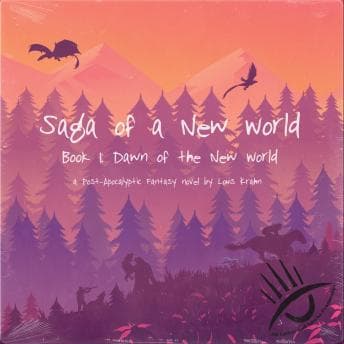

Author-narrated LitRPG-adjacent post-apocalyptic fantasy is either your exact thing or absolutely not, and I respect that binary.
I was deep into a procrastination spiral — had my thesis proposal open on one monitor, my Audible library on the other, and my advisor's last email sitting unread like a threat — when I clicked into Dawn of the New World. Magic apocalypse destroys civilization, survivors wake up in a world with monsters and stat-like progression? Yeah, Dr. Patel's email could wait another 13 hours.
The Setup Rolls a Natural 20 (The Execution Rolls... Lower)
Here's the pitch: modern world gets hit by a magical cataclysm, and Astrid wakes up in the aftermath where technology still exists but magic has fundamentally rewritten the rules. It's giving System Apocalypse vibes — think Tao Wong meets early Randidly Ghosthound. The premise is strong. Survivors banding together, figuring out new abilities, scavenging through the bones of the old world while monsters roam around. My D&D group would love this as a campaign setting, honestly. The blend of modern tech ruins with emerging magical systems scratches a very specific itch. Robin Hobb does something similarly ambitious with layered world-building in Ship of Magic — different genre entirely, but that same feeling of a richly constructed sandbox that demands patience before it pays off.
But here's where I have to be straight with you. This is a Book 1 in the truest, most setup-heavy sense. A lot of the 13-hour runtime is spent establishing the world, introducing the ensemble cast around Astrid, and laying groundwork for what's clearly meant to be a longer saga. The progression is there — Astrid and the other survivors start discovering what they can do — but it's more slow-burn foundation than payoff. If you don't like info-dumps, this isn't for you (but you're wrong). I personally don't mind a book that takes its time building the sandbox before letting you play in it, but I can see how some listeners might feel like the pacing drags in the middle stretch, especially around hours 5-8 where the survival logistics get pretty granular.
The world-building itself? Solid concept. The idea that magic didn't just replace technology but merged with it in unpredictable ways is genuinely interesting. There are moments where you can feel Krahn geeking out about his own creation, and that enthusiasm is infectious even when the execution doesn't always stick the landing.
The Author-Narrator Gamble
Louis Krahn wrote this AND narrates it, which is always a coin flip. On one hand, nobody knows the material better. You can hear the intentionality in how he paces certain reveals — he knows what matters because he built it. On the other hand, narrating a 13-hour audiobook is a completely different skill set from writing one, and Krahn is clearly more writer than performer.
The narration is... functional. It gets the job done. He reads with clear diction and you can follow the story without confusion, which honestly puts him ahead of some indie audiobooks I've suffered through. But the character differentiation is limited — when you've got an ensemble survival group, you really need distinct vocal signatures to keep track of who's talking, and that's not consistently here. Steven Pacey walked so other narrators could run, and Krahn is still figuring out how to crawl in that department. It's not bad enough to ruin anything, but after 13 hours you start wishing for a dedicated narrator who could inject more life into the dialogue scenes.
The production quality is clean, at least. No weird background noise, no jarring edits that I caught. That counts for something in the indie space.
Who's Rolling Initiative on This One
If you're a LitRPG/System Apocalypse fan who's chewed through the big names and you're hunting for new series to start, this is worth a look. The magic-meets-technology angle gives it its own flavor, and Book 1s in this genre are basically character creation sessions — you're investing now for payoff later. I will defend LitRPG with my dying breath, and this one has enough going on to justify the time.
If you need polished narration or tight, fast-paced plotting to stay engaged, pump the brakes. This is indie in every sense — ambitious ideas, rough edges, and a clear love for the genre that doesn't always translate into professional-tier execution.
Yes, it's a 13-hour commitment. No, it won't replace your Sanderson relistens. But I read this instead of writing my thesis, and I don't regret it. Much.
Tom's Thesis-Avoidance Verdict
It's a promising start to a series that needs its next book to really prove itself. The world has legs. Astrid is likable enough to follow. The magic system has potential even if Book 1 only scratches the surface. I'm cautiously interested in where this goes, but I'd wait for a sale or grab it on a streaming subscription rather than burning a full credit. Krahn's got ideas — he just needs either a stronger editor or a dedicated narrator (or both) to level up from "interesting indie" to "must-listen."