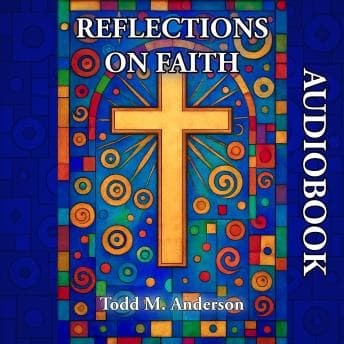

Look, I'm going to be honest here - this is pretty far outside my usual wheelhouse. I picked up Reflections on Faith during a particularly brutal on-call week when my usual sci-fi queue felt too demanding and I needed something... slower. Something I could zone in and out of without losing plot threads. And that's basically what I got.
The thing is, Todd Anderson's approach to faith is less systematic theology and more personal memoir with spiritual commentary. Which is fine! But if you're coming from a more analytical background (hi, that's me), it can feel a bit frustrating. He's not building arguments - he's sharing experiences. His guided meditation technique, "The Filament Above the Waters," is central to the book, and honestly? I kept waiting for more explanation of the mechanics. Like, what's actually happening here? What's the framework? But that's not really the point, is it.
Two Books Duct-Taped Together
Here's where I got stuck: this book is trying to be two things at once. It's a personal faith journey (the prodigal son stuff, finding your way back, trusting what you can't see) AND it's a practical guide to meditation and spiritual practice. Some reviewers compared it to Eckhart Tolle's The Power of Now, and I can see that - same emphasis on present-moment awareness. Untethered Soul sits somewhere between the two - more structured than Anderson but still pretty abstract. But Tolle builds a more coherent framework. Anderson's approach is more... experiential. You're basically getting his visions and revelations and hoping they spark something in you.
For some people, that's exactly what they want. The "walk by faith, not by sight" crowd will probably find this genuinely meaningful. But I kept wanting to debug the system, you know? Like, show me the architecture. Give me reproducible steps. (Yes, I know that's missing the point. Kevin tells me I try to optimize everything, including things that shouldn't be optimized.)
Michael Mola at 1.25x
The narration is solid. Michael Mola has this clear, engaging tone that works well for reflective content. His pacing is deliberate - not slow, but measured. You can tell he's giving you space to actually think about what's being said, which is appropriate for this kind of book. Some listeners mentioned his accent can be a bit much, but honestly, I didn't find it distracting. At 1.25x it smoothed out nicely.
What I appreciated: he doesn't oversell the emotional moments. There's a temptation with spiritual content to get really breathy and dramatic, and Mola avoids that. He sounds like a thoughtful person reading you something meaningful, not a motivational speaker trying to pump you up.
The production quality is mostly fine, though I did notice some background noise in a few sections. Not deal-breaking, but noticeable on a quiet train car.
The ROI Question
Okay, so here's the practical breakdown. At 6.5 hours, this is about 3-4 commutes for me. Is it worth that time?
If you're already on a faith journey and want something contemplative - probably yes. If you're into meditation and curious about how someone integrates that with Christian spirituality - worth a shot. If you're looking for evidence-based arguments or systematic frameworks - hard pass.
I finished it. I didn't regret finishing it. But I also didn't have any major revelations. Maybe that says more about where I am than where the book is.
The meditation technique itself is interesting enough that I might actually try it sometime. (Don't tell anyone on my team. They already think I've gone soft since I started listening to anything that isn't hard sci-fi or distributed systems podcasts.)
Who's This Actually For?
For the right person, sure. This is basically The Power of Now but for Christians who want personal narrative over philosophy. Falling Upward has a similar vibe - faith-based, contemplative, heavy on the personal journey stuff. Perfect for: Sunday mornings, long walks, winding down before bed. Skip if you need logical structure to engage, or if you're commuting somewhere that requires you to stay sharp.
If you're curious about faith-based meditation but find most spiritual books too abstract, Anderson's personal stories might be the entry point you need. Just don't expect a technical manual.