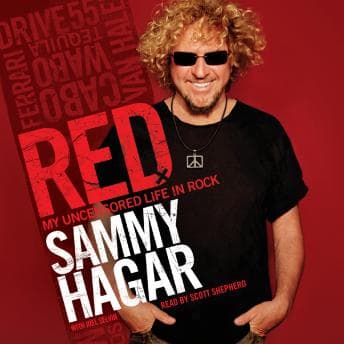

Look, I'm an English teacher. I've spent two decades convincing teenagers that literature matters, that the written word has power, that Hemingway's sparse prose says more than a thousand adjectives ever could. And here I am, grading papers at 11 PM, listening to Sammy Hagar talk about groupies and tequila.
My students would be so proud. Or horrified. Probably both.
Here's the thing about rock memoirs - they're basically the opposite of everything I teach. No careful structure. No thematic unity. Just a guy at a bar telling you stories until last call. And Red is exactly that. Sammy Hagar doesn't write like Fitzgerald. He writes like your uncle at Thanksgiving after his fourth beer, except your uncle never jammed with Eddie Van Halen or invented a tequila empire.
The Voice That Sells It
Scott Shepherd's narration is doing something sneaky here. He's channeling Hagar's California dude energy so convincingly that I kept forgetting this wasn't Sammy himself reading. That authentic voice imitation matters more than you'd think - rock memoirs live or die on whether you can hear the personality behind the words. Shepherd nails the pacing, the casual delivery, the way Hagar probably tells these stories to friends over drinks at Cabo Wabo.
The production is clean, professional, nothing fancy. Which is right. You don't need sound effects or music beds when the stories themselves are this wild. Just a voice, telling you about the time things got completely out of hand. Again.
Where the Rambling Works (And Where It Doesn't)
I'll be honest - this book meanders. If I graded it as a narrative essay, I'd be reaching for my red pen constantly. (Yes, I still use red pen. I'm ancient, remember?) Hagar jumps around, circles back, goes off on tangents about business deals and band drama and the specific details of rock star excess that would make my principal's eyes pop out.
But here's what I realized somewhere around hour four, walking the lakefront while Denise pretended not to notice I was laughing out loud: the rambling IS the point. This isn't a carefully constructed memoir. It's a guy who's lived an absurd life trying to get it all down before he forgets. The lack of polish is the authenticity.
That said - and I mean this - the "uncensored" part of the title isn't marketing. The language is rough. The stories about bandmates get uncomfortable. There are moments where Hagar's honesty feels less like confession and more like score-settling. If you want a diplomatic, everyone-comes-out-looking-good rock biography, this ain't it.
What Hemingway Would Say (He'd Hate It, But That's Fine)
I keep thinking about what makes a memoir work. The classics I teach - Augustine's Confessions, Montaigne's Essays - they're about self-examination, about finding meaning in experience. That search for meaning drives Short and Tragic Life of Robert Peace in ways that make it feel almost painfully literary by comparison. Hagar's not really doing that. He's not searching for deeper truths about the human condition. He's telling you about that time at that show with that girl and holy crap you won't believe what happened next.
And you know what? That's okay. Not every book needs to be Middlemarch. Sometimes you need seven hours of rock and roll war stories to remind yourself that life can be ridiculous and excessive and fun. My students would probably like this more than anything on my syllabus.
(Don't tell them I said that.)
The Van Halen years get the most attention, obviously. The tension with Eddie, the creative battles, the eventual split - it's all here, told from Sammy's perspective with all the bias that implies. If you're a diehard David Lee Roth fan, you might want to skip this one. But if you've ever wondered what it was like inside one of rock's most volatile partnerships, Hagar holds nothing back.
Who's Getting an A, Who's Getting Detention
This one's for Sammy Hagar fans (obviously), rock memoir junkies, and anyone who wants their commute soundtracked by tales of excess. Skip it if you need literary structure, prefer diplomatic band histories, or can't handle rough language and score-settling honesty.
Class Dismissed
At seven and a half hours, this is a solid commute listen. I burned through it over two weeks of lakefront walks and late-night grading sessions. Shepherd's narration kept me engaged even when the stories started blending together - how many tales of excess can one man accumulate? (Answer: a lot. The man accumulated a lot.)
If you're into rock memoirs generally, it's a good addition to the collection - maybe not as tightly written as some, but more honest than most. If you're looking for literary merit... well, that's not really the assignment here.
My mom definitely won't be listening to this one for my podcast. But I enjoyed every rambling, R-rated minute of it.






![Steve Jobs [unabridged audiobook] audiobook cover](/_next/image?url=https%3A%2F%2Fcovers.audiobooks.com%2Fimages%2Fcovers%2Ffull%2F9788499923406.jpg&w=1920&q=75)