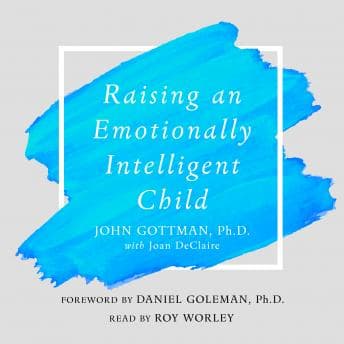

"The opposite of an emotionally intelligent response is dismissing what the child feels."
I was chopping onions for a chana masala when that line landed, and I actually put down the knife. Not because it was revolutionary — any halfway decent therapist would tell you the same thing — but because Gottman frames it with twenty years of longitudinal data from his lab at the University of Washington, and the specificity of his evidence hit different. He's not guessing. He watched families. He measured heart rates. He tracked outcomes over years. And what he found is that the single biggest predictor of a child's emotional health isn't whether parents set firm boundaries or give warm hugs. It's whether they treat the child's negative emotions as opportunities for connection rather than problems to fix.
That's the core of Emotion Coaching, and honestly? It's the core of this entire book.
Why a Non-Parent Spent Eight Hours on a Parenting Book
Look, I don't have kids. I study how narratives shape identity, and Gottman's framework is basically narrative psychology applied to parenting. He argues that when a parent helps a child label their emotions — "You're feeling frustrated because your tower fell down" — they're doing something profoundly identity-forming. They're teaching the child that their internal experience has structure, has language, has legitimacy. The research actually shows that children whose parents practice Emotion Coaching have better vagal tone (a physiological marker of emotional regulation), perform better academically, and have fewer behavioral problems. And Gottman doesn't just throw stats at you. He walks through case studies — real families from his research — where you can see the difference between a dismissing parent and an Emotion Coaching parent responding to the exact same tantrum.
The four parenting styles he identifies (Dismissing, Disapproving, Laissez-Faire, and Emotion Coaching) are presented with self-assessment questionnaires, which is where the audiobook format gets slightly awkward. Roy Worley reads the questions aloud and you're supposed to... score yourself mentally? While jogging? I ended up pausing repeatedly during these sections, which broke the flow. If you're someone who needs to interact with the material, the print version might serve you better for those chapters specifically.
But here's what Gottman gets right that so many parenting books get wrong: he doesn't pretend Emotion Coaching means permissiveness. He's very clear — you can validate the feeling while still setting limits on the behavior. "You're angry that your sister took your toy. It's okay to be angry. It's not okay to hit her." That distinction is psychologically precise in a way I genuinely respect.
The Marriage Chapter Nobody Expects
There's a substantial section on how marital conflict affects children's emotional development, and I found myself asking: why does Gottman bury this gold in a parenting book? His data on how children's stress hormones spike when exposed to certain types of parental conflict — not all conflict, but contemptuous, stonewalling conflict — is genuinely alarming. He distinguishes between marriages where conflict is managed with mutual respect versus marriages characterized by his famous "Four Horsemen" (criticism, contempt, defensiveness, stonewalling). Children in the latter homes showed chronically elevated cortisol levels. The protagonist of this chapter — if I can treat the data that way — is a five-year-old whose body is essentially in fight-or-flight mode during dinner because mom and dad can't disagree without someone rolling their eyes.
My therapist would have thoughts about how many adults walking around today are still carrying that cortisol signature.
Roy Worley Does the Job (But Just the Job)
The narration is clean, professional, and entirely serviceable. Worley has the kind of steady, measured voice that works for educational content — you trust him, you can follow the arguments, nothing distracts. But there's no particular warmth or personality that elevates the material. When Gottman describes emotionally charged moments between parents and children, Worley reads them with the same even tone he uses for the research methodology. It's not bad. It's just... flat where it could be affecting. At eight hours, the monotone pacing made a couple of the middle chapters feel longer than they needed to be. I bumped it to 1.25x during the questionnaire sections and never went back.
Who This Is (and Isn't) For
Parents who want evidence-based strategies rather than Instagram platitudes — this is your book. People working through their own childhood stuff in therapy — honestly, this might explain some things. You'll recognize the dismissing or disapproving patterns from your own parents and it will sting. Be ready for that.
If you want a quick-hit parenting hack book, this isn't it. Gottman is thorough, sometimes repetitive, and very committed to making sure you understand the research before he gives you the playbook. The same demand for patience over shortcuts applies to Arnold Bennett's How to Live on Twenty-Four Hours a Day — another slim, deceptively rigorous book that refuses to hand you a hack when it can hand you a framework instead. The payoff is worth the patience, but it requires actual patience.
The Case File Stays Open
This is a fascinating case study in what happens when rigorous research meets practical wisdom. Gottman doesn't just tell you what to do — he shows you why it works, neurologically and developmentally. The fact that this book is from 1997 and the science still holds up says something. Not everything ages well. This did. I finished it while the chana masala simmered, and I'll be thinking about those cortisol studies for a while.