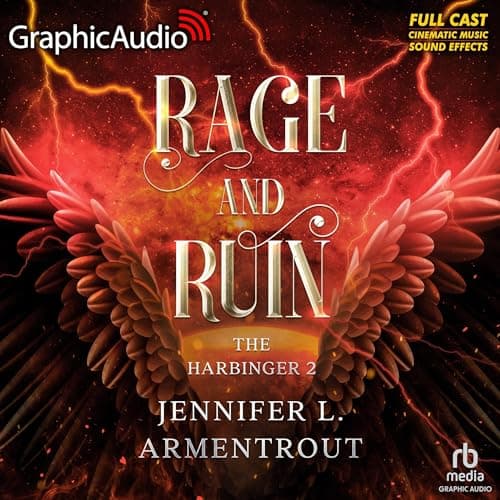
I'll be honest — when I saw this was a dramatized adaptation with a full cast of twenty-five actors, sound effects, and cinematic music, I expected it to feel overproduced. Like one of those audio dramas where the explosions are louder than the dialogue and every emotional beat gets underscored with swelling strings until you can't feel anything anymore. That's not what happened here.
Rage and Ruin picks up where Storm and Fury left off, throwing Trinity and Zayne headfirst into a DC that's crumbling under demonic forces. Trinity — half-angel, mostly stubborn, legally blind but supernaturally lethal — is trying to track down the Harbinger, an entity slaughtering both Wardens and demons without any discernible pattern. Meanwhile, she and Zayne are bonded protector and charge, which means they're spending every waking hour together while pretending their feelings aren't spiraling into territory that could literally destroy them both. Jennifer L. Armentrout knows exactly what she's doing with that slow-burn tension, and the dramatized format cranks it up even higher than the original audiobook.
Tanja Milojevic carries Trinity's POV with real bite. She doesn't soften Trin's anger or sand down the edges of her frustration — and in a book literally called Rage and Ruin, that matters. The character is furious a lot of the time, and Milojevic lets you feel it without tipping into melodrama. Robb Moreira's Zayne hits the right notes too: steady, warm, with just enough tension underneath to sell the tortured-protector dynamic. The rest of the cast fills out the world convincingly, and I was surprised how quickly I stopped tracking which actor was playing which role and just... lived in it.
The production team at GraphicAudio clearly put thought into the sound design. Combat scenes have weight and spatial awareness — you can track movement, feel impacts, sense when something is closing in from a direction Trinity can't see. That last detail matters because Trin's visual impairment isn't just a character trait; it shapes how she experiences danger, and the audio production uses that. That kind of sensory storytelling — where the format itself becomes part of the meaning — is something I chased all the way through Deathworld, which does something similarly clever with environmental hostility and how its protagonist processes threat. When she's relying on other senses, the soundscape shifts to meet her perspective. It's the kind of smart production choice that justifies the dramatized format existing alongside the original narration.
The romance between Trinity and Zayne deepens in ways that feel earned rather than engineered. There's a particular satisfaction in hearing two characters verbally dance around what they both know is happening, and the full-cast format means you're getting genuine chemistry between performers rather than one narrator switching between voices. Those quiet moments — the loaded pauses, the half-finished sentences — land differently when two real voices are creating them.
Where the book itself sometimes stumbles is in the middle section. Armentrout is juggling apocalyptic stakes, a mystery about the Harbinger's identity, political maneuvering among Wardens, and the romance, and there are stretches where the plot feels like it's treading water while waiting for the next revelation. The dramatized format helps here more than it should — the sound design and music keep energy flowing through scenes that might drag on the page — but you can still feel the story stalling before it rockets toward its conclusion.
And that conclusion. I was listening during a late-night drive when the final act kicked in, and I genuinely had to pull over during one twist because I was too busy yelling at my dashboard to focus on the road. The action sequences in the last two hours are relentless, and the emotional payoffs hit hard enough that I needed a minute before starting anything else.
One complaint I've seen from other listeners is the cast change from the first book's adaptation. If you bonded with a specific voice for these characters, switching performers can feel jarring. It took me about thirty minutes to adjust, and after that, it wasn't an issue. But I understand the frustration — voice attachment is real, and it's a valid concern if you're coming straight from Storm and Fury's dramatized version.
Who Should Listen (And Who Should Skip)
If you're already invested in this series and curious about the full-cast treatment, this is the format doing exactly what it's supposed to do. The dramatized production elevates the source material in ways that surprised me — I genuinely think I caught emotional subtleties I would have glossed over in a standard single-narrator version. Skip it if you're not caught up on Storm and Fury (this is a deep middle-book entry, no hand-holding) or if cast changes between installments are a dealbreaker for you. At just under eleven hours, it deepens the mythology, escalates the stakes, and develops the central relationship without rushing toward resolution — and it made me forget I was listening to a production and feel like I was standing in that world.