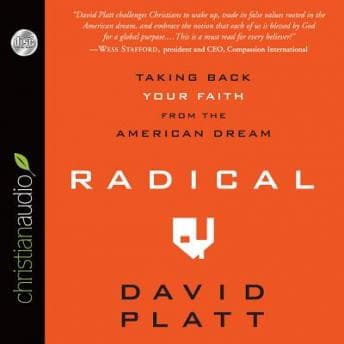

"They would leave behind security, money, convenience, even family for him." That line hit me somewhere around Chapter 1, right while I was reviewing a pitch deck for a fintech startup promising "frictionless wealth." The irony wasn't lost on me.
My parents didn't come to America to abandon security. They came to Koreatown, worked 14-hour days in a dry cleaner, and saved every penny so I could have security. They chased the American Dream with a ferocity that would scare a Navy SEAL. So listening to David Platt tell me that the American Dream is basically the enemy of authentic faith? That's a hard pill to swallow.
But here's the thing—he's right. And that's annoying.
THE ROI OF COMFORT VS. THE CROSS
Most business books I read are about optimization. How to get more for less. Radical is the opposite. It's about negative ROI on a worldly balance sheet. Platt argues that we've sanitized the gospel to fit our suburban, safety-obsessed lives.
As a consultant, I look for misalignment. Platt points out the massive gap between "carry your cross" and "buy the bigger SUV." He's not subtle about it. He shreds the idea that you can have your comfortable life and your radical faith too.
(Jenny, my wife, listened to about ten minutes of this over my shoulder and said, "Well, that's heavy." Understatement of the year.)
It reminds me of the startups that fail because the founders want the exit without the grind. Platt is saying modern Christians want the heaven without the sacrifice. It's uncomfortable to listen to because he strips away the "passive income" version of spirituality where you just show up on Sundays and call it a day.
PLATT BEHIND THE MIC
Platt narrates this himself. Usually, author-narrators are a gamble. Most should stick to writing. But Platt is a pastor—a professional speaker. He's not reading; he's preaching.
His voice is earnest. Almost too earnest. You can hear the guy's conviction—he actually believes this stuff deeply enough to make you feel guilty for owning a Nespresso machine.
One caveat: the audio quality has issues. There's some weird processing on the 's' sounds (sibilance) that pierced right through my noise-canceling headphones. If you're an audiophile, it's going to bug you. I had to mess with the EQ in my car to stop the hissing.
Also, at my usual 2.0x speed, Platt sounds manic. He's got this intense, pleading cadence that turns into a panic attack when sped up. I had to dial it back to 1.5x just to keep my heart rate down.
WHO SHOULD HIT PLAY (AND WHO SHOULDN'T)
If you're a Christian who's been feeling a little too comfortable—too optimized for safety—this is your wake-up call. Skip it if you want affirmation that your current lifestyle is fine. Also skip if audio quality issues drive you crazy or you refuse to slow down from 2x speed.
THE PIVOT CALL
Look, I spend my life telling companies they need to pivot or die. Platt is doing the same thing for the soul.
Is it extreme? Yes. He talks about capping your lifestyle and giving everything else away. My parents would look at this guy and ask if he's lost his mind after all that hard work. But deep down, they'd respect the hustle. They understood sacrifice.
This isn't a "feel-good" listen. It's a "feel-bad-then-do-something" listen. That's the opposite energy of Sorry Not Sorry, which is all about celebrating your wins without the guilt trip. If you want a pat on the back, go listen to Joel Osteen. If you want a strategic audit of your life that might actually change your Q4 goals, give this a shot. Just maybe don't listen to it on the way to a luxury vacation. It ruins the vibe.