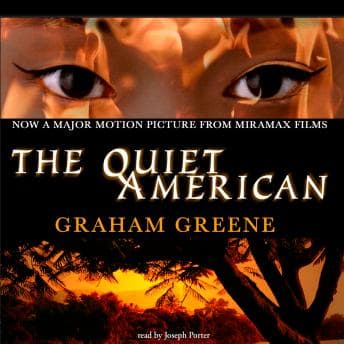

Graham Greene knew something in 1955 that took the rest of America another decade to figure out. That's the first thing that hits you listening to The Quiet American — not the love triangle, not the Saigon streets, but the prophetic dread of a novelist who'd already seen how idealism with a passport and a budget becomes something monstrous.
I finished this one during a late Saturday walk along the lakefront with Denise. She was talking about her sister's kitchen renovation and I was nodding along while Fowler was watching Saigon burn, and let me tell you, the cognitive dissonance was something. There's a moment where Fowler describes the aftermath of a bombing in a public square — bodies, bicycle parts, a woman holding what used to be her baby — and Greene writes it with this clinical detachment that somehow makes it worse than any graphic description could. Fowler's refusal to feel becomes its own kind of violence. I had to stop walking for a second. Denise asked if my knee was acting up again. I said yes. It wasn't.
Greene Wrote the Blueprint for Every "Are We the Baddies?" Conversation
Here's what the author is really saying, and it's not subtle, but it doesn't need to be: Alden Pyle is the most dangerous kind of American abroad. Not cruel. Not corrupt. Earnest. He's read his York Harding, he's got his Third Force theory, and he genuinely believes he's helping. Greene makes Pyle polite, well-meaning, almost likable — and that's the knife. Because Pyle's abstraction of democracy gets real people killed, and he processes those deaths the way a grad student processes a failed hypothesis. Interesting. Let me adjust.
Fowler, the cynical British journalist who narrates, keeps insisting he's not "engagé" — not involved, not taking sides. This is Greene's other joke. Fowler's uninvolvement is itself a position, a kind of imperial exhaustion dressed up as wisdom. And Phuong, the Vietnamese woman caught between them, barely gets to be a person in either man's version of events. She's a symbol for both of them — Vietnam itself, fought over by men who think they know what's best for her. Greene doesn't let anyone off the hook. Not the idealist, not the cynic, not the reader.
At six hours and forty-one minutes, this is lean. Greene's prose has always been stripped down, almost journalistic, and it works beautifully in audio because every sentence carries weight without excess. The prose deserves to be savored. There's no fat. If you loved The Heart of the Matter or The End of the Affair, this is their political cousin — same Catholic guilt, same moral exhaustion, but aimed outward at empire instead of inward at God.
Joseph Porter and the Problem of Pyle's Voice
So here's where I have to be honest, and it genuinely pains me because the source material is so good. Joseph Porter narrates with a kind of BBC-inflected gravity that works well enough for Fowler — there's a weariness to his delivery that fits a man who's spent too many years in colonial outposts drinking and filing copy. When Porter reads Fowler's internal monologue, that slightly nasal quality actually serves the character's exhausted irony.
But Pyle. Oh, Pyle.
The American accent Porter attempts for Alden Pyle is — and I'm being generous here — distracting. It's the kind of American accent that sounds like someone learned it from watching one season of a television show and decided that was enough. For a character whose entire identity hinges on being specifically, recognizably American — earnest Ivy League American, State Department American, the kind of American who says "democracy" like it's a brand name — the voice needs to land. It doesn't. Every time Pyle speaks, you're pulled out of Greene's carefully constructed tension and dropped into an accent exercise.
This matters more than it would in another book because the Fowler-Pyle dynamic IS the book. Their conversations carry the entire philosophical weight of the novel. When Pyle's voice doesn't convince, those scenes lose their edge. You're listening to the ideas instead of feeling them. And Greene wrote this so you'd feel them.
(My students would hate this book, by the way. Too slow, too political, nobody they can root for. I love it.)
Who Gets the Assignment
If you're a Greene reader — if you already know what "Greeneland" means — this audiobook will give you the text at a perfectly serviceable level despite the narrator issues. Listen at 1.0x. The author chose those words and the silences between them. If you're coming to Greene for the first time, I'd actually suggest starting with a different title in audio and reading this one on paper, because Pyle's voice is too central to stumble over.
This is required listening for anyone who wants to understand America's relationship with the rest of the world. It was written seventy years ago and it could've been written last Tuesday. That's why we still read the classics. Though I'll admit, not every "classic" earns that label — I sat through Demon Crown recently and kept thinking about how much craft separates a thriller that merely moves fast from one that actually means something.
Worth Pausing the Faculty Meeting For — But Maybe Read This One Instead
The book itself is a quiet, devastating piece of political fiction that hasn't aged a day. Greene's genius was writing a love triangle that's actually about imperialism, and an espionage story that's actually about self-deception. Five stars for the novel, no question. But this particular audio production stumbles where it matters most — in giving America its proper voice. And in a book called The Quiet American, that's not a small thing.









