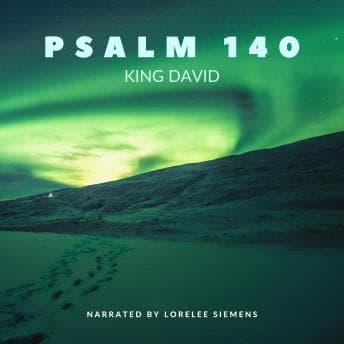

"Deliver me, O Lord, from the evil man: preserve me from the violent man."
Two minutes. That's all this is. I put it on during one of those rare quiet moments at the kitchen table - Denise had gone to bed, papers were graded, and I was just sitting there with my tea going cold. Two minutes of Psalm 140, and I sat still for all of it.
Two Minutes That Ask You to Be Quiet
Let me be upfront about what this is and isn't. This is a single psalm - a prayer attributed to David, a man crying out for protection from enemies who sharpen their tongues "like a serpent" and hide snares along his path. It's not a book. It's not even a chapter. It's a two-minute recording, and rating it alongside twelve-hour novels feels a bit like comparing a haiku to a Faulkner sentence. But here we are.
What struck me - and this is the English teacher talking, not the churchgoer - is how the language of Psalm 140 moves from raw fear to stubborn trust in about ninety seconds. David doesn't build an argument. He doesn't theologize. He just names his enemies, describes their cruelty with some genuinely vivid imagery (the serpent's poison under their lips is Old Testament poetry at its sharpest), and then pivots to a declaration of faith that he hasn't earned through logic. He's earned it through desperation. That pivot is the whole psalm. That's the human condition in miniature. That same raw, untheologized cry toward something bigger than yourself - earned through suffering rather than argument - is what I kept thinking about when I reviewed I Am Number 8: Overlooked and Undervalued, but Not Forgotten by God, which wrestles with that same desperate trust from a completely different angle.
My students would hate this. I love it.
Lorelee Siemens Understands That Silence Is Part of the Text
Siemens reads this the way it should be read - slowly, with space between the verses. The narrator understands that pause is punctuation. In a two-minute piece, pacing is everything. Rush it, and it becomes background noise. Drag it, and it turns precious. She finds the middle ground - there's an emotional weight to her delivery without melodrama. When David says "I know that the Lord will maintain the cause of the afflicted," she lets the certainty in that line land. She doesn't push it. She trusts it.
I will say this: with a recording this short, there's not much room for a narrator to develop range or demonstrate versatility. It's one voice, one mood, one prayer. So evaluating the narration is a bit like evaluating a singer on a single sustained note - you can tell the instrument is good, but you're working with limited data. What I can say is that nothing pulled me out of the text. No odd inflections, no misplaced emphasis. She served the psalm. That's the job.
The Value Problem (Let's Just Address It)
Here's where I get honest. Two minutes of audio. I've had sneezing fits longer than this recording. As a piece of devotional listening - something to bookend a prayer, to center yourself before sleep, to carry with you on a short walk to the mailbox - it works. It does what it sets out to do.
But as an audiobook purchase? That's harder to justify. You're paying for a single psalm that you could read in your own Bible in thirty seconds. What you're really paying for is Siemens' interpretation, her pacing, her voice giving the ancient words a particular texture. And that interpretation is solid. Whether it's worth a credit is a different question entirely.
If you're someone who uses audio psalms as part of a daily practice - putting one on while you sit with your coffee, or playing it in the car before you walk into a difficult day - this format makes sense. If you're looking for an audiobook experience in any traditional sense, this isn't it. And that's fine. Not everything has to be.
Who This Is For (And Who Should Keep Scrolling)
This is for the person who already knows they want to hear Psalm 140 read aloud by someone who takes it seriously. If that's you, Siemens delivers. Her pacing invites you to sit with each verse rather than skim past it, and that's genuinely valuable for devotional use.
If you're browsing for your next audiobook - something to fill a commute or a long walk - keep scrolling. This isn't that. It's a breath, not a journey.
The Lesson Plan Is One Line Long
David wrote this psalm while people were actively trying to destroy him. And his response was to talk to God like God was standing right there. No hedging. No formality. Just - help me. Protect me. I trust you.
Two minutes. Sometimes that's enough to say everything.