
"The dictionary is a history of the language, not a law book."
That line hit me around hour three, somewhere between client calls on a Tuesday afternoon. I'd been half-listening, expecting another dry business history dressed up as something more interesting. Instead, Winchester delivers what might be the most compelling case study in organizational behavior I've encountered outside an MBA classroom—and it's about a dictionary.
Bottom line: This is a 7-hour audiobook with maybe 5 hours of truly essential content, but those 5 hours are worth every minute.
Two Obsessives Walk Into a Project
Here's what business books get wrong about innovation: they focus on the visionary at the top. Winchester does something smarter. He gives us Professor James Murray, the driven academic overseeing the Oxford English Dictionary's creation, and Dr. W.C. Minor, a Civil War veteran and—here's the twist—a murderer confined to an asylum for the criminally insane. Minor contributed over ten thousand definitions. From a padded cell.
My parents would've understood Minor's work ethic, honestly. Man had nothing but time and chose to spend it documenting word origins with surgical precision. That's not madness. That's purpose. The madness was everything else.
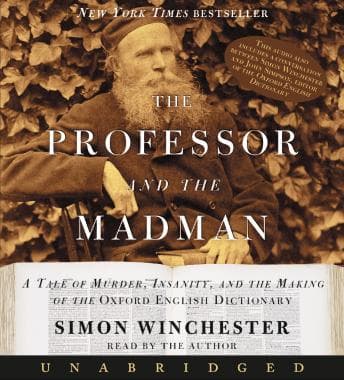
Winchester narrates his own work, and there's something intimate about hearing an author read their obsession. He switches between his natural English delivery and a Scots accent for Murray's dialogue—took me about twenty minutes to catch the pattern. Once I did, it became a clever shorthand. Murray's Scots burr carries the weight of working-class determination; the smoother English tones handle the institutional scenes. It's subtle. Maybe too subtle for 2.0x speed, which is why I dropped to 1.5x around chapter two.
The Consulting Lesson Nobody Asked For
Look, I've sat in rooms where Fortune 500 executives debate whether to outsource basic functions. The OED committee essentially crowdsourced their entire research operation in the 1870s. Volunteers across the English-speaking world submitted quotations on slips of paper. The logistics alone would give modern project managers nightmares.
And their most prolific contributor? A man who'd shot a stranger in London, convinced the man was an Irish assassin sent to kill him. The committee didn't know this for years. They just kept receiving perfect, meticulous work.
There's a lesson here about judging output over credentials. Also about due diligence. Also about how institutions handle uncomfortable truths. Winchester doesn't hammer these points—he's too elegant for that—but they're there if you're listening for them.
Where It Drags (And Where to Skip)
The middle section on Victorian asylum conditions runs long. Important context, sure, but Winchester's journalistic instincts sometimes override narrative momentum. He wants you to understand the full horror of Minor's confinement, the barbaric treatments, the isolation. Noble goal. Also adds about an hour that could've been thirty minutes.
Skip to the final third if you're pressed for time. That's where the relationship between Murray and Minor deepens, where Winchester's research really shines. The scene where Murray finally visits Minor at Broadmoor—I won't spoil it, but Jenny walked in while I was listening and asked why I looked "upset about a dictionary book." Fair question.
Who Should Queue This Up (And Who Shouldn't)
If you're interested in language, history, or the strange alchemy of institutional projects, this is essential listening. If you've ever wondered how massive collaborative efforts actually work before Slack and Asana, here's your answer: slowly, chaotically, and often driven by people the institution would rather not acknowledge.
Not for you if you want a straight biography. Winchester weaves between timelines, between Murray's Oxford and Minor's asylum, between 1870s London and Civil War battlefields. Will Smith's autobiography takes a similar approach—jumping between eras to build emotional momentum rather than following a clean chronological line. It rewards attention. Background listening while answering emails? You'll miss too much.
Net-Net on the Seven Hours
Seven hours, author-narrated, about a dictionary. Sounds like a hard sell. But Winchester makes the OED's creation feel like a heist movie—decades-long, methodical, dependent on an unlikely alliance between respectability and madness.
My parents built their business on systems. Dry cleaning tickets organized by color codes, customer preferences memorized, alterations tracked in a notebook my mother still has. That's what Minor did, essentially. He built a system. He just happened to be doing it while convinced demons were tormenting him at night.
The key takeaway is worth the listen. The other 7 hours? Actually, most of them are too. That's rare for me to say.