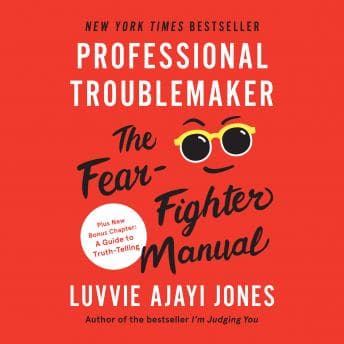

I'm going to say it: I was getting real tired of Luvvie telling me about her grandmother by hour six.
There. I said it. And I feel guilty because Grandma Funmilayo sounds like an absolute force of nature - the kind of Nigerian matriarch who would've taken one look at my night shift schedule and told me to demand better hours or start my own hospital. But after the fifteenth reference, I found myself muttering "I KNOW, she was fearless, we've established this" while pulling into my driveway at 7:30 AM.
Here's the thing though - Carlos asked why I was crying in the car. I blamed allergies. It was not allergies.
When Your Big Sister Won't Let You Off The Hook
Luvvie reads her own work, and thank God she does. Her voice has this warmth that cuts through the 3 AM brain fog like nothing else. When she drops into Yoruba - there's an actual recording of her aunt speaking it that's audio-only content you won't get in the print version - it grounds everything. Makes you feel like you're sitting in someone's kitchen getting real talk, not reading a self-help book written by someone who's never actually struggled.
The book splits into three sections: Be, Say, Do. Simple framework. The execution? That's where it gets messy. And I mean that as both a compliment and a criticism.
Luvvie talks about nearly skipping her TED talk because of imposter syndrome. As someone who's actually worked a code on a patient while a new resident stood frozen behind me, I felt that in my bones. We all have moments where our brain screams "you're not qualified for this" while our hands keep moving because someone has to. She gets that. She really does.
But she also wants to tell you every story she's ever lived while making that point.
The Repetition Problem (Or Is It?)
Here's where I'll defend what other reviewers have criticized. Yes, it's repetitive. Yes, she circles back to the same themes. Yes, some of her personal digressions feel like they're overshadowing the actual advice.
But - and this is a big but - night shift brain sometimes needs things repeated. I listened to this across maybe eight drives home, exhausted, running on caffeine and spite. The repetition meant I actually retained something. By the fifth time she hammered home "the things we must do are more significant than our fears," it had actually sunk into my sleep-deprived skull.
Is that great writing? Debatable. Is it effective audiobook strategy? For me, absolutely.
The f-bombs are frequent, by the way. If that bothers you, this isn't your book. If you're a trauma nurse who's heard worse from patients, families, and occasionally yourself at 4 AM, you'll feel right at home.
The Memoir-Self-Help Identity Crisis
This book doesn't know what it wants to be. It's part memoir, part self-help manual, part love letter to Nigerian grandmothers everywhere. Some listeners found this frustrating - the premise is muddled, they say. It's a chore to get through.
I get it. If you're looking for a tight, actionable self-help book with clear steps and minimal personal anecdotes, you're going to be annoyed. Luvvie's not here to give you a five-step plan. She's here to be your long-lost big sister who sees right through your excuses. That same no-nonsense energy runs through 12 Rules for Life, though Peterson's less likely to drop f-bombs about it.
My mom would love this (she still thinks I should've been a doctor). She'd also probably tell me Luvvie talks too much, which - fair.
Who Needs This In Their Ears (And Who Doesn't)
This is for you if: you're stuck in your own head, afraid to speak up, afraid to take up space, afraid to be "too much." If you've ever apologized for having opinions. If you need someone to yell at you with love. Self-Reliance makes similar points about trusting yourself, though Emerson's a lot less chatty about his grandmother.
Skip it if: you want efficient self-help. If repetition makes you want to throw your phone out the car window. If you're looking for a tight five-step plan instead of kitchen-table wisdom.
Perfect for that post-shift decompression, honestly. Luvvie's energy matches that weird 7 AM headspace where you're too tired to be cynical but too wired to sleep.
Clocking Out
At 8 hours and 35 minutes, this is a commitment. The AudioFile Earphones Award it won is deserved - Luvvie's comedic timing is genuinely great, and her emotional moments land without feeling manipulative. She sounds like she's talking TO you, not AT you.
Did I yell at my dashboard during this one? Only once, when she made a point I needed to hear and I wasn't ready. That's different.
It's not perfect. It's messy and repetitive and sometimes feels like it's trying to be three different books at once. But it's also real in a way that most self-help isn't. Luvvie's been afraid. She admits it. She did the scary things anyway.
Sometimes that's enough.