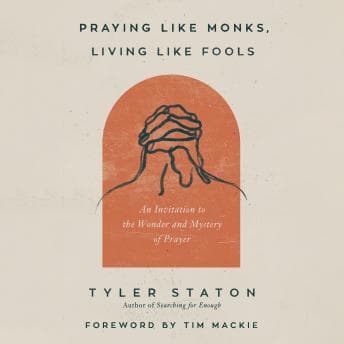

Look, I have a complicated relationship with prayer books. Most fall into two camps: either they're so theological they feel like homework, or they're so feel-good they could've been written by a motivational poster. Eight hours is a lot to ask when I've got a stack of strategy frameworks waiting and clients who need their decks by Monday.
But here's the thing. Tyler Staton opens with something that actually made me pause my 2.0x speed: "Prayer is a search for help outside the self." That's it. That's the whole premise. And in a culture obsessed with self-optimization and hustle porn—trust me, I've read all those books—that's a genuinely countercultural statement. Tweak: Growing Up on Methamphetamines explores a different kind of search for help outside the self—one that went catastrophically wrong.
When McKinsey Meets Monasticism
Staton does something clever here. He's not just telling you to pray more. He's essentially doing a root cause analysis on why prayer feels broken for most people. The obligatory morning routine that becomes another checkbox. The confusion when prayers seem to bounce off the ceiling. The guilt spiral when you realize you've gone weeks without talking to God about anything real.
This is what my parents did instinctively. Sunday mornings at the Korean church in Koreatown, my mom's hands folded over her apron after closing the shop at 9 PM, my dad's quiet moments before the steam presses started up. They didn't need a framework. But I apparently do, and Staton provides one without making it feel like a productivity hack.
He walks through different postures—silence, persistence, confession—and each one gets enough depth to actually be useful. The section on silence hit different. I was listening during a red-eye to Chicago, couldn't sleep, and Staton's talking about how we're terrified of quiet because we might actually hear something we don't want to. At 35,000 feet with nothing but engine noise, that landed.
The Tim Mackie Factor
If you've listened to The Bible Project, you know Tim Mackie's voice. Clear, measured, the kind of delivery that makes complex ideas feel accessible without dumbing them down. He narrates most of the book, with Staton himself jumping in for certain sections. The handoff works—Mackie brings the teaching weight, Staton brings the pastoral warmth.
No dramatic voice acting here. No swelling orchestral moments. Just two guys who clearly believe what they're saying, talking directly into your ears. For a book about prayer, that stripped-down production actually makes sense. You're not getting entertained into spiritual growth. You're getting invited.
Fair warning: some listeners reported Audible playback issues—cutting out, erratic sound, problems when the screen goes dark. I didn't experience this on my setup, but worth knowing if you're planning to listen during a workout or with your phone locked.
What Actually Sticks
This one earns its runtime. Staton doesn't pad. He tells stories that illustrate without meandering, pulls from church history without getting academic, and keeps circling back to practical application.
He's honest about disappointment in prayer. About the times it doesn't work the way you expected. About the tension between "ask and you shall receive" and the reality of unanswered prayers. That honesty is what separates this from the prosperity gospel adjacent stuff that makes me want to throw my AirPods out the window.
I've seen leaders at companies I've consulted for try to manufacture meaning through vision statements and values workshops. It never works. You can't engineer soul into an organization—or a person. Staton seems to get that prayer isn't a technique to master but a relationship to enter. Revolutionary? No. But refreshingly un-optimized.
Skip If You Want a Formula, Stay If You've Lost the Thread
If you're looking for a prayer formula, skip this. If you want someone to tell you that prayer is magic and your life will transform in 30 days, skip this. If you're a skeptic who thinks all religion is delusion, you'll hate it.
But if you grew up in church and lost the thread somewhere, or you're curious about spiritual practice without the cringe, or you're just tired of self-help books that put you at the center of the universe—this might be the reset you need.
Jenny would say I'm being soft. Jenny is right. But she also knows I don't recommend spiritual books lightly. This one earned it.
The Dry Cleaning Shop Test
My parents never read books about prayer. They just prayed. Through 14-hour days and difficult customers and the fear that comes with building something in a country that wasn't yours. Staton's book doesn't capture that exactly—how could it? But it points toward the same thing they knew: that prayer isn't about getting something from God. It's about being with God.
Bottom line: Worth your time. Worth slowing down to 1.5x. Worth the eight hours.