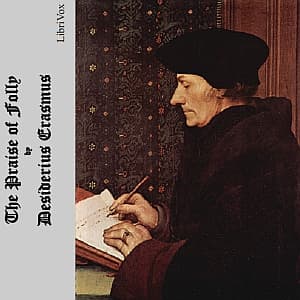

So here's something I never expected to say: I spent Sophie's Tuesday nap time listening to a 500-year-old satirical essay about how stupidity basically runs the world, and I was genuinely entertained. I'd grabbed this on a whim because it was under four hours (my sweet spot) and I figured, hey, if a Renaissance scholar can roast the entire Catholic Church and live to tell about it, maybe I can survive another day of goldfish cracker negotiations.
Folly Herself Would Love the School Drop-Off Line
Here's the setup: Folly — as in, the personification of foolishness — gets up on a stage and delivers a speech about why she's actually the most important force in human life. Love? That's folly. Marriage? Definitely folly. (Erasmus was clearly onto something there, 500 years before anyone coined the phrase "the mental load.") The whole first chunk is genuinely funny in this dry, almost stand-up way. Folly argues that without her, no one would get married, have children, or accomplish anything at all, because all of those things require a healthy dose of self-delusion.
I literally laughed out loud during drop-off when Folly explained that friendship only works because people agree to overlook each other's faults. That's... just my mom friend group chat. That's exactly what that is.
But then Erasmus shifts gears. Hard. The middle section turns into a pretty pointed takedown of monks, theologians, and church officials who hide behind ritual and titles while missing the actual point of their faith. It gets dense. The references pile up — Greek philosophers, Latin quotes, biblical allusions — and this is where you feel the 1509 of it all. I won't pretend I caught every reference. I'm working with a bachelor's in marketing, not a classics degree. But the general thrust — powerful people using complicated nonsense to avoid being held accountable — that landed just fine. DeLillo does something similar in White Noise — that same creeping sense that the institutions around us are performing authority more than actually wielding it, and somehow that's scarier than anything.
Anna Simon vs. Renaissance Latin (A Mixed Bag)
Anna Simon reads this solo, and she brings genuine energy to it. Folly is supposed to be theatrical and a little unhinged, and Simon leans into that. There's a liveliness to her delivery that kept me from zoning out during the denser philosophical stretches, which is saying something when you're also mentally calculating whether you have enough diapers to make it to Thursday.
But. The mispronunciations. They're there and they're noticeable. Latin names, Greek references — some of them come out a little sideways. It's the kind of thing that might drive a classics professor up a wall. For me? Honestly, it was only mildly distracting. I'm not exactly cross-referencing the original Greek while folding tiny socks. But if you're someone who cares deeply about the correct pronunciation of "Lucian" or various theological terms, fair warning.
The production is clean and simple — no sound effects, no music, just Simon and the text. At 3 hours and 43 minutes, this is basically a long podcast episode. I finished it across two nap times and one glorious car-sit in the garage. Survived 47 pauses and still made sense — well, as much sense as a satirical lecture by the literal embodiment of Stupidity can make.
Who This Is Actually For (And Who Should Run)
Look, I'm not going to pretend this is my usual lane. My recent listens include two Emily Henry novels and a cozy mystery set in a bakery. This is a 16th-century philosophical satire written in Latin and translated into formal English. The sentences are long. The humor is dry as communion wine. There are no meet-cutes.
But it's SHORT. And it's surprisingly funny in spots. And there's something kind of thrilling about listening to a guy who lived 500 years ago say the same things about performative religion and intellectual arrogance that people are arguing about on Twitter right now.
If you want something light and breezy — this isn't it. If you want a romance — absolutely not. But if you're a curious reader who wants to feel slightly smarter during nap time without committing to a 20-hour history book, this scratches that itch. My book club would love this (if I ever have time for book club again) — it's short enough that people might actually read it, and the "what counts as folly" conversation could go on for hours.
Not groundbreaking for me personally, but sometimes you don't need groundbreaking. Sometimes you need a dead Dutch guy to remind you that the whole world has always been a little ridiculous, and that's weirdly comforting.
The Mom Verdict: Weird But Worth Your Nap Time
At under four hours, this is basically free. The narration is spirited if imperfect. The content swings between laugh-out-loud and "I should Google that later." I'm not going to re-listen to it, but I'm genuinely glad I spent Sophie's nap on Erasmus instead of scrolling my phone. And that's more than I can say for a lot of books that are supposedly written for people like me.