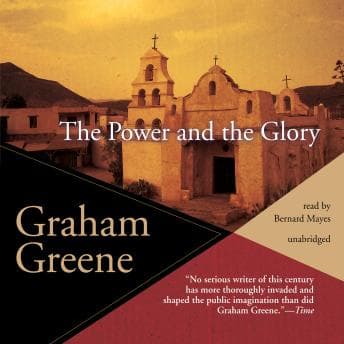

I was grading a stack of junior essays on Crime and Punishment at 11:30 PM—the irony of reading about Raskolnikov's guilt while marking papers about it was not lost on me—when I switched on this audiobook. By midnight, the essays were forgotten. Denise found me at 1 AM, red pen still in hand, completely absorbed in 1930s Mexico.
Graham Greene's whisky priest had me by the throat.
The Priest Nobody Wants to Root For (But You Will)
Here's what Greene does that still feels radical: he gives us a protagonist who is, by any conventional measure, a failure. An alcoholic. A father to an illegitimate child. A coward who runs when he should stand. And yet—and yet—this unnamed priest stumbling through the Mexican jungle becomes one of the most compelling figures in twentieth-century fiction.
This is why we still read the classics. Greene understood something my students struggle with when we discuss moral complexity: virtue isn't the absence of sin. It's what you do when you're broken and terrified and still choosing to serve something larger than yourself. The whisky priest knows he's damned. He believes it. And he keeps hearing confessions anyway, keeps offering communion with shaking hands, keeps being a priest in the only way he knows how.
Bernard Mayes captures this beautifully. His reading has a weariness to it—not tiredness, but the bone-deep exhaustion of a man who can't stop doing the thing that will kill him. When the priest encounters Padre José, the married priest who chose survival over vocation, Mayes shifts into something almost pitying. José's humiliation comes through in every syllable.
What Greene Is Really Saying
I tell my students that great literature asks questions it refuses to answer. Greene structures this novel as a pursuit—the police lieutenant hunting the last priest—but it's really about two men who believe absolutely in their opposing visions of salvation. The lieutenant wants to save the poor through secular revolution. The priest wants to save souls through grace. Both are willing to die for their beliefs.
Neither is entirely wrong. That's the uncomfortable genius of it.
The Mexico Greene depicts—where the Red Shirts have outlawed God and systematically murdered clergy—was real history. The Cristero War. My students are always shocked to learn this happened in the 1930s, not the 1530s. The violence isn't gratuitous, but it's present. Religious persecution rendered with the clear-eyed honesty of a man who converted to Catholicism as an adult and never lost his skepticism about the institution.
Mayes reads Greene's prose the way it deserves—at a pace that lets the moral weight settle. The narrator understands that pause is punctuation. There are moments of near-silence where you can feel the priest's terror, his shame, his strange stubborn faith.
The Nine-Hour Commitment
At just over nine hours, this isn't a quick listen. It's also not a background listen. I tried putting it on while walking the lakefront with Denise one Saturday and had to stop three times to explain what was happening. She finally told me to just finish it alone. (She prefers her walks with less theological crisis.)
The pacing is deliberate. Greene was never interested in rushing toward resolution. If you've loved The End of the Affair or The Heart of the Matter, you know his rhythm—that slow accumulation of detail and conscience until suddenly you're staring at a character's soul laid bare.
My one reservation: Mayes is known for historical classics, and his approach here is appropriately measured. But there are moments—particularly in the more action-oriented sequences—where I wanted a bit more urgency. The chase through the jungle could use more breathlessness. It's a minor complaint. The emotional delivery in the quiet scenes more than compensates.
Who Should Wrestle With This (And Who Should Walk Away)
If you loved Silence by Shūsaku Endō, this is its spiritual predecessor. Both ask what faith costs when the price is your life. Both refuse easy answers. All the King's Men wrestles with similar questions about corruption and redemption, though Warren's setting is American politics rather than religious persecution.
Skip this if you need likeable protagonists or clear moral victories. The whisky priest will frustrate you. He frustrated me. That's the point.
My students would hate this. Too slow, too internal, too concerned with questions they think they've already answered. I love it. Worth pausing the faculty meeting for—and I did, twice, when Principal Martinez was explaining the new attendance software.
Class Dismissed
Greene called this his best work. He wasn't wrong. The prose deserves to be savored, and Mayes gives it the reverence it requires. This is a novel about grace finding the least deserving vessel and working through him anyway. Uncomfortable and beautiful, it stayed with me for days after the final chapter.
I finished those Crime and Punishment essays eventually. But I kept thinking about Greene's priest—how Dostoevsky and Greene were asking the same questions across a century, across continents. What redeems us. Whether we can be redeemed at all.
That's the conversation great literature invites you into. This audiobook is a worthy entrance.









