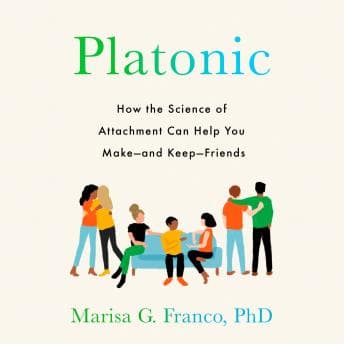

"Assume people like you."
I was chopping onions for a dal I'd eat alone (by choice, truly) when Franco dropped this line somewhere around hour three. I actually stopped mid-chop. Because here's the thing—the research shows that most of us operate under what she calls a "liking gap." We chronically underestimate how much people enjoy our company. My therapist would have thoughts about how long I've been doing this.
This is a fascinating case study in applying attachment theory beyond romantic relationships—territory I've been curious about since my dissertation work. Franco takes the anxious-avoidant-secure framework we typically reserve for dating and asks: what if this explains why you haven't texted your friend back in three weeks? What if your avoidant attachment style is why you have acquaintances but not intimates?
When a Researcher Reads Her Own Research
Franco narrating her own book works here in ways author-narration often doesn't. Her voice has this warmth—perky without being grating—that makes eleven hours of psychological research feel less like a lecture and more like getting coffee with that friend who happens to have a PhD. (We all need one of those friends. This book might help you find yours.)
What makes her performance compelling is the genuine investment. When she discusses the studies, you can hear she's not just summarizing—she's synthesized this material, lived with it, probably argued about it at conferences. The passion translates. No monotone academic detachment here.
The Myth of Organic Friendship (And Why It's Hurting You)
The protagonist of this book—and yes, I'm treating friendship itself as a character, because that's what I do—exhibits classic avoidance patterns that Franco systematically dismantles. We've been told friendships should "just happen." That if you have to try, something's wrong. Franco calls this out as the harmful fiction it is.
The research shows friendship requires intentionality. Repeated exposure. Vulnerability that feels uncomfortable. She provides what she calls "exercises" throughout—prompts for reflection, action steps for the anxiously attached, different ones for the avoidant. I found myself asking: why does our culture treat romantic love as worthy of effort but friendship as something that should materialize like magic?
Franco isn't peddling toxic positivity or suggesting you can manifest your way to a social circle. She's offering evidence-based strategies with the acknowledgment that this is hard work, especially for those of us whose attachment patterns were set decades ago.
Where It Gets Clinically Interesting
For my fellow psychology enthusiasts: Franco weaves in studies on propinquity (physical proximity's role in friendship formation), the mere exposure effect, and research on how different attachment styles sabotage connection. The anxiously attached over-pursue and exhaust potential friends. The avoidant maintain such rigid boundaries that no one can get close enough to matter.
Psychologically, this tracks. I've seen these patterns in research subjects, in case studies, in—let's be honest—my own behavior. The chapter on how to identify your attachment style and its specific friendship pitfalls felt uncomfortably accurate.
But here's my critique: Franco occasionally oversimplifies the plasticity of attachment. She's optimistic about change in ways that some longitudinal research doesn't fully support. Attachment styles can shift, but it's messier than the book sometimes suggests. Still—for a general audience self-help book, she's more rigorous than most.
Who Needs This (And Who Doesn't)
If you've ever wondered why maintaining friendships feels like a second job you're failing at, this is your book. If you're post-college, post-pandemic, post-any-major-life-transition and realizing your social circle has quietly evaporated—Franco wrote this for you.
Skip it if you want pure theory without application. This is practical, sometimes uncomfortably so. That action-oriented approach reminds me of Automatic Millionaire, which similarly refuses to let you stay in the comfortable realm of just knowing better. Franco wants you to actually do things differently, not just understand friendship intellectually. (I'm still working on the doing part. The understanding came easier.)
Case Closed, Now What?
I finished this audiobook three days ago. I've since texted two friends I'd been "meaning to reach out to" for months. Not because Franco guilted me into it, but because she reframed the act. Reaching out isn't desperate or needy—it's what secure attachment looks like in practice.
The dal turned out well, by the way. And I'm considering inviting someone over to share the next batch. That's probably the highest compliment I can give a friendship book: it made me want to stop eating alone. Sometimes.