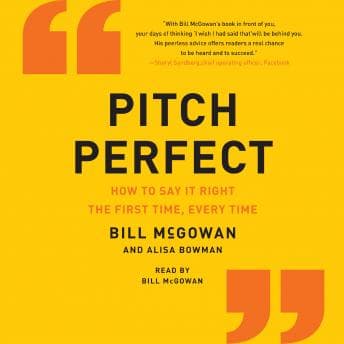

I'm going to be honest with you. I've sat through approximately 847 presentations on "how to communicate better" in my consulting career. Most of them were delivered by people who couldn't hold a room's attention if they were literally on fire. So when I picked up Pitch Perfect, I was already half-annoyed. Another communication guru telling me to "be authentic" while reading from a teleprompter? Pass.
But Bill McGowan - and this is the part where I have to eat my words - actually knows what he's doing.
The Consultant's Dilemma: Is This Actually Useful?
Here's what separates McGowan from the usual TED Talk crowd: the man has receipts. Eli Manning. Jack Welch. The C-suites at Spotify, Airbnb, Dropbox. These aren't people who hire coaches to feel good about themselves. They hire coaches because saying the wrong thing in a board meeting costs real money.
The "Principles of Persuasion" framework he lays out? I've seen variations of this work at three different Fortune 500 companies. The difference is McGowan packages it in a way that's actually implementable. That tactical precision reminds me of what Robert Greene does in Mastery - breaking down complex skills into concrete, repeatable steps. He's not giving you abstract theory - he's giving you scripts. Specific phrases. The exact moment to pause. I listened to this at 2.0x during my morning runs, and I still caught myself slowing down to actually absorb certain sections. That's rare for me.
The actionable advice on presentations alone is worth the price of admission. How to handle hostile questions. How to recover from a flub. How to read a room that's already checked out. This is what my parents did instinctively when negotiating with suppliers at the dry cleaning shop - they just never had a TED talk about it.
When the Author Gets in His Own Way
Okay, so here's the thing. Some listeners have complained about political commentary - specifically some praise for Hillary Clinton - and yeah, I noticed it. Did it derail the book for me? No. Did it feel unnecessary? Absolutely.
McGowan is at his best when he's teaching, not when he's showing off his client list or his political preferences. There are moments where the name-dropping gets a little thick. Yes, we get it - you've worked with famous people. The Kelly Clarkson anecdote was good. The fifth celebrity reference in twenty minutes? Less so.
Jenny would say I'm being harsh. Jenny is right. But also - this is a book about saying the right thing at the right time, and sometimes McGowan doesn't take his own advice.
McGowan Behind the Mic
McGowan narrates his own book, which - for a communication coach - is basically a job interview. And he passes. His delivery is clean, professional, appropriately paced. No weird vocal tics. No over-dramatic pauses that make you want to throw your AirPods into traffic.
Is it electric? No. Is it competent? Very. And honestly, for a business book, competent is a gift. I've suffered through too many author-narrated books where you can hear them reading instead of speaking. McGowan sounds like he's coaching you over coffee, which is exactly the vibe this book needs.
The ROI Calculation
At just under 8 hours, this is lean for a business book. McGowan respects your time more than most. The core principles are solid, the examples are concrete, and unlike 80% of my Audible business library, I actually finished this one.
Who should listen? Anyone who has to present, pitch, or persuade for a living. Founders doing investor meetings. Managers handling difficult conversations. Small business owners who need to close deals without a sales team. Who should skip? If you're allergic to any political commentary - even mild stuff - you might get irritated. And if you're already a seasoned communicator, some of this will feel like review. But even I picked up two or three techniques I'm planning to use in my next client workshop, so there's value even for the experienced.
The key takeaway is worth the listen. The other 7 hours? Mostly worth it too. That's higher praise than I give most business books these days.