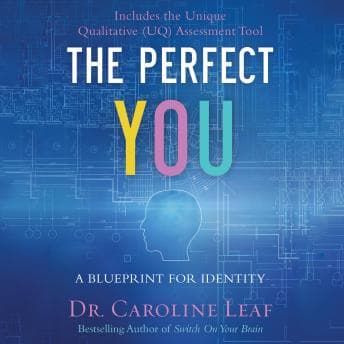

Seven and a half hours of someone telling me I can't be categorized, using a system that... categorizes me.
Let that sink in for a second. Dr. Caroline Leaf's Perfect You builds its entire thesis on rejecting personality tests and labels, then spends the bulk of its runtime walking you through her own framework - the "Unique Qualitative (UQ) Assessment" - which is, functionally, another personality test. It's dressed up in neuroscience language and wrapped in Scripture, but the irony is thick enough to cut with a McKinsey slide deck.
I listened to this one during a late-night deep clean of our kitchen. Jenny was asleep, I had a stack of dishes that needed attention, and I figured a self-help book about identity would be low-stakes background listening. Wrong. This one actually demands your focus, not because the ideas are particularly dense, but because Leaf's seven-step framework is layered and self-referential in ways that punish half-attention. Step three builds on step one's vocabulary, step five assumes you remember the distinctions from step four. Zone out for ten minutes and you're lost.
The Neuroscience Dressed in Sunday Clothes
Here's where I have complicated feelings. Leaf is a communication pathologist and cognitive neuroscientist, and she does make scientific concepts accessible - there's a section on how comparison and envy literally damage brain tissue that actually made me pause the dishes and rewind. That's a strong claim backed with enough citation to be interesting, even if I'd want to see the primary research before repeating it at a dinner party. She connects toxic thinking patterns to measurable neurological outcomes, and when she's in that lane, the book earns its shelf space.
But then the framework pivots hard into faith-based identity work - your "divine purpose," your God-designed uniqueness - and if you're not in that headspace, you'll feel the gear-shift. I grew up in the Korean church. I sat through more sermons than board meetings by age 18. I'm not allergic to spiritual frameworks in practical books. The closest I've come to that same uneasy blend of sacred text and practical listening is James Earl Jones Reads the Bible: The King James Version of the New Testament — which at least has the honesty to be exactly what it says it is. But Leaf blends the two without always flagging when she's left the science and entered theology, and that's going to frustrate listeners who picked this up expecting pure cognitive neuroscience.
My parents would've had zero patience for this book, by the way. Not because of the faith element - they'd have been fine with that. But because the practical application is buried under so many conceptual layers. My mom figured out her identity running a dry cleaning counter for 14 hours a day. She didn't need seven steps. She needed sleep.
Margaret Winston Does the Heavy Lifting
Winston's narration is clean and professional - she handles the scientific terminology without stumbling, and her pacing keeps the denser sections from becoming a wall of jargon. It's a workmanlike performance. Not electric, not distracting. She reads like a calm professor walking you through a syllabus, which is exactly what this material needs. I wouldn't seek out her other work specifically, but she doesn't hurt the experience.
The production is straightforward - no sound effects, no music cues, just a single narrator delivering what is essentially a lecture with spiritual interludes. At 2.0x, some of the scientific terminology started blurring together, so I actually dropped to 1.5x for the first time in months. That tells you something about the density, or maybe about my aging ears. Jenny would say both.
The 45 Minutes of Gold Inside 7.5 Hours
The key takeaway is worth the listen. The other 7 hours? Not so much. Leaf's core insight - that most personality frameworks are reductive, that your thinking pattern is genuinely unique, and that comparison creates measurable neurological harm - is powerful stuff. Chapter 5 onward, where she gets into the UQ profile and practical exercises, is where the actual utility lives. The first four chapters are a slow on-ramp of philosophy and justification that could've been condensed to thirty minutes.
The seven-step framework itself (awareness, reflection, connection, etc.) is solid but not revolutionary. I've seen variations of this in executive coaching programs at three different firms. What Leaf adds is the neuroscience backing and the spiritual dimension, which will either elevate or alienate depending on your worldview.
Here's my honest assessment: this is a 3-star book with 4-star moments. When Leaf is connecting brain science to identity work, it's genuinely useful. When she's padding chapters with repetitive encouragement about how special you are, it reads like a self-help book that doesn't trust its audience to stay engaged without constant affirmation.
Who Gets the ROI
Faith-based listeners interested in neuroscience will love this. If you're in a Christian book club and want something with more intellectual rigor than the average devotional, this delivers. If you're a secular listener looking for pure cognitive science on identity and self-concept - skip to chapter 5, take what you need, and move on. Thank me later.
Bottom line: There's a genuinely interesting 3-hour book trapped inside a 7.5-hour runtime. The neuroscience-meets-faith angle is unique enough to justify a listen, but not a credit. Borrow it, skim strategically, and don't feel guilty about what you skip.