
"The America we know is about to be lost forever."
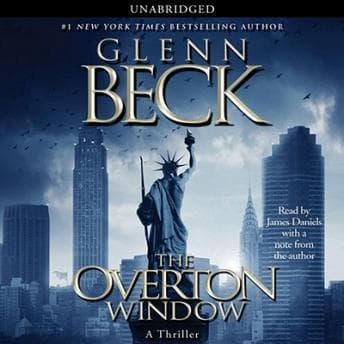
That line hits somewhere around hour two, and I'll be honest—I was grading sophomore essays on *The Great Gatsby* when it landed. Denise was already asleep. The house was quiet except for James Daniels' voice in my earbuds and the scratch of my red pen. And I thought: well, this is certainly a different kind of American Dream story.
Let me be clear about something before we go further. Glenn Beck wrote a political thriller. If you're expecting him to leave his worldview at the door, you haven't been paying attention to... well, Glenn Beck. The man has a perspective, and *The Overton Window* is essentially that perspective wrapped in a conspiracy plot with a romance subplot bolted on. Whether that's a feature or a bug depends entirely on what you're looking for.
The Concept Is Actually Fascinating
The Overton Window itself—the political theory, not the book—is genuinely interesting. It's the idea that there's a range of acceptable political discourse at any given time, and that range can be shifted gradually until yesterday's radical becomes tomorrow's mainstream. As an English teacher who's watched language and acceptable ideas shift dramatically over two decades in the classroom, I find the concept intellectually honest, even if the application here is... let's say, pointed.
Noah Gardner is our protagonist: wealthy, disconnected, the kind of guy who thinks politics happens to other people. Then he meets Molly Ross, who's basically the opposite—a true believer convinced that shadowy forces are manipulating the country. The romance between them is functional rather than electric. It exists to give Noah a reason to care about something beyond himself. Beck isn't Austen. (My students would say "obviously, Mr. Williams." They're not wrong.)
The terrorist attack sequence is where Daniels really earns his AudioFile Earphones Awards. The chaos, the confusion, Noah's disorientation—it's dramatically effective. You feel the ground shift. The narration captures that specific American anxiety we've all felt since 2001, that sense that the world could change in an instant.
James Daniels Deserves Better Material
Here's the thing about this audiobook: James Daniels is a genuinely talented narrator working with uneven prose. His voice has this charming quality—warm, authoritative, the kind of voice you'd want reading you the news during a crisis. He moves between characters with consistency, giving Noah a kind of entitled smoothness that gradually roughens as the character wakes up to reality. His Molly is earnest without being shrill, which is harder than it sounds.
But Daniels can't fix dialogue that reads like position papers. There are moments—too many moments—where characters stop being characters and start being mouthpieces. I noticed Daniels navigating the same tension in Midnight Bayou—carrying material that leans on mood over substance—and he's just as committed there. A good narrator can smooth over a lot of sins, and Daniels does his best, but even his impeccable delivery can't disguise when we've left storytelling territory and entered lecture mode.
Beck himself narrates the foreword and conclusion, which is a nice touch. It's also a reminder that this is, at its core, a Glenn Beck production. If you're on board with that, you'll find the framing effective. If you're not, well, you probably stopped reading this review three paragraphs ago.
Who This Is Actually For (And Who Should Run)
This is for listeners who already agree with Beck's politics and want a thriller that validates their worldview. And honestly? That's fine. We all read—or listen to—books that confirm what we already believe sometimes. There's a reason Ayn Rand still sells. (My students groan when I assign *Anthem*. I assign it anyway.)
If you're looking for a nuanced exploration of political manipulation that doesn't have a predetermined conclusion, skip this one. Agent Running in the Field does something more honest with the genre—its politics are just as present, but le Carré lets the contradictions breathe instead of resolving them neatly. If you want characters who feel like people rather than chess pieces in an ideological argument, look elsewhere. But if you want a competently performed thriller with a specific perspective and you share that perspective, you'll probably enjoy the nine hours.
The pacing is solid. The conspiracy mechanics are reasonably well-constructed. The post-attack sequences are genuinely tense. It's not a bad thriller—it's a partisan thriller, which is a different thing entirely.
Mr. Williams' Final Grade
Not quite worth pausing the faculty meeting for. This is a book that does exactly what it sets out to do, for exactly the audience it's written for. Daniels' performance elevates material that often reads like a radio monologue dressed in narrative clothing. The Overton Window as a concept deserves a more literary treatment—something that examines the phenomenon without already having decided who the villains are.
But as political thrillers go, it's competent. As audiobook performances go, Daniels is excellent. As literature? This reminds me of what Orwell said about political writing—that it's almost always propaganda dressed in other clothes. At least Beck is honest about which clothes he's wearing.