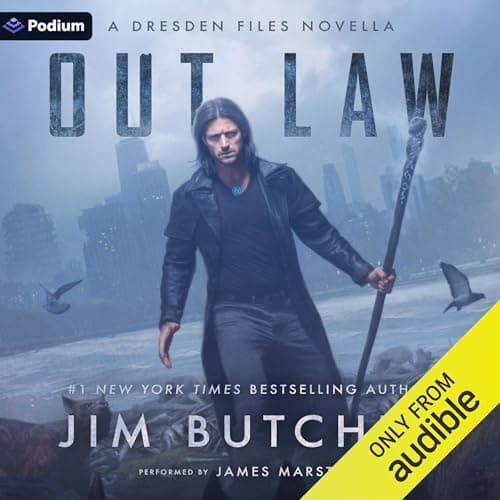

What happens when an author asks you to trust a character who's spent seventeen-plus books earning that trust — and then puts him in a situation where trust itself is the weapon being used against him?
I was three miles into a snowshoe circuit along the ridge above my cabin, January air so cold it burned the back of my throat, when Marcone showed up in Harry Dresden's castle asking for a favor. And I thought — out loud, to no one but the chickadees — 'Oh, here we go.' Because Gentleman John Marcone doesn't ask. He leverages. Butcher knows this. Marsters knows this. The way Marsters drops his register for Marcone's voice, this low controlled authority that sits about two octaves below Harry's wisecracking cadence, you can feel the power imbalance before a single plot point lands.
The Debt That Walks Like a Demon
The premise here is pure Dresden: an honorable debt forces Harry into someone else's mess, and that mess turns out to be connected to consequences he set in motion years ago when he wiped out the Red Court. Butcher is doing something I respect — he's not letting Harry off the hook for the ecological cascade of destroying an entire vampiric power structure. Nature doesn't forgive mistakes. Neither do I. And apparently neither does the Dresdenverse. The demon antagonist here isn't just a monster-of-the-week; it's an invasive species that filled the vacuum Harry created. That's how ecosystems actually work. Remove a keystone predator and something worse moves in. The ecology here is spot-on, even if we're talking supernatural ecology. I kept thinking about Grace and Glory while chewing on this — another genre entry where the power vacuum left by one supernatural faction becomes the whole engine of the plot, and the author actually respects what fills the void.
At four hours and ten minutes, this is a tight novella. No bloat. Butcher's working in a compressed space and it shows — the pacing moves like a controlled burn through dry timber. You get the setup with Marcone, the complication with the lowlife seeking redemption (and Harry's justifiable skepticism about that redemption), and then the confrontation with something that feeds on blood and ambition in equal measure. The comedic beats land — Harry's internal monologue about owing Marcone is genuinely funny, that stubborn self-awareness Butcher writes so well — but the humor doesn't undercut the stakes.
Marsters at a Whisper, For Better and Worse
Here's where I've got to be honest. I've been listening to Marsters do Dresden for years. He IS Harry Dresden in my head. But something's different in Out Law. There's a tiredness in his voice — a whispery, muffled quality that I first noticed during the quieter expository passages. Snowshoeing at 8,000 feet with earbuds in, wind cutting across exposed ridgeline, I had to stop and crank the volume twice in the first hour alone. The dramatic whispers Marsters uses for tension? They disappear into ambient wind noise. That's a real problem for anyone listening outdoors or in a car.
Now — is it possible this is a deliberate choice? Harry's been through hell. He's healing in his castle. Maybe Marsters is performing a more weathered, beaten-down version of Dresden. If so, I get the artistic intent. But the execution makes it hard to actually hear the performance in anything less than dead silence. His character differentiation is still strong — Marcone's controlled authority, the nervous energy he gives the underling seeking redemption, the way Harry's voice tightens when he realizes what he's actually fighting — all of that lands when you can hear it. The comedic timing is still there in the quips. But you're working harder as a listener than you should be.
Who Should Listen (And Who Should Skip)
If you've been with the Dresden Files through the long haul, this novella is Butcher doing what he does best: consequences. Harry doesn't get to make world-altering decisions and walk away clean. The demon antagonist — this insatiable thing born from the power vacuum Harry created — functions as a mirror. And Butcher's smart enough not to spell that out in neon letters. He trusts the reader.
If you're new to Dresden? Walk away. This is not your entry point. The emotional weight of the Marcone dynamic, the significance of the Red Court's destruction, Harry's relationship with his apprentice — none of it lands without the context of at least a dozen previous books. This is a story written for people who've been walking this trail a long time.
Where I'd Stake My Tent
I finished this one coming down the ridge as the light went flat and gray, that particular Montana winter light where the mountains lose all depth. Four hours felt right for the story Butcher wanted to tell. Not every story needs to be a full novel, and Butcher respects the novella form here — no padding, no filler, just a clean arc with real consequences. Marsters' performance would've been a clear win if the audio levels matched his intent. As it stands, you're getting an A-minus performance trapped in B-minus audio. Listen in a quiet room. Don't fight the wind for it.