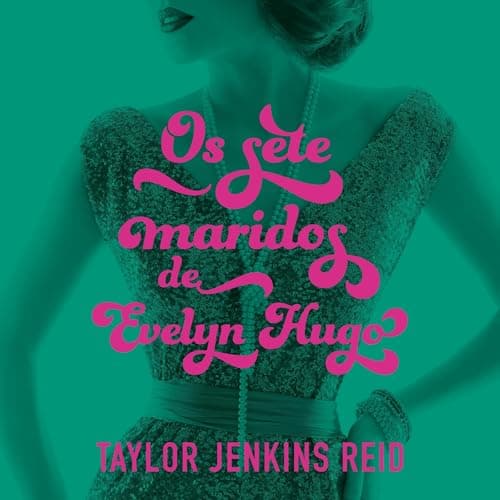

"Eu sou Evelyn Hugo. E minha história, a verdadeira, vai surpreender você."
Somewhere around hour two, that line hit me while I was walking the lakefront with Denise on a Sunday morning — Lake Michigan doing its best impression of the Pacific, wind cutting through my jacket — and I stopped mid-stride. Denise asked if I was okay. I wasn't, really. I was already gone, pulled into 1950s Hollywood by a fictional actress who makes the real golden-age icons look like amateurs.
Let me be upfront: this is a Brazilian Portuguese audiobook. The Audible listing says Spanish, which is wrong. It's Portuguese. And if you can follow it — or if you're learning — this version is something special.
Seven Husbands, One Secret, Zero Wasted Pages
Taylor Jenkins Reid built something clever here. The seven-husbands structure could've been a gimmick — a countdown, a listicle dressed up as literature. But each marriage functions like a chapter in an argument Evelyn is making about herself. Husband one teaches her what power looks like. Husband three teaches her what love costs. By husband five, you realize the husbands aren't really the point. They're scaffolding around the actual story, which is about a woman who spent sixty years hiding the one person she loved most.
The revelation of Evelyn's secret love — and I won't spoil who — lands with real force because Reid doesn't rush it. She lets you piece it together the way Monique Grant, the young journalist interviewing Evelyn, pieces it together. You start catching details around hour four or five. Small things. The way Evelyn describes certain glances, certain rooms. And then the floor drops out. This reminds me of what Hemingway said about writing — the dignity of an iceberg is that only one-eighth of it is above water. Reid keeps most of the truth submerged until you're ready to see it.
Three Voices Carrying Sixty Years
The three-narrator setup — Adriana Ferreira, Márcia Caspary, and Yazi — works because Evelyn's story spans decades and perspectives. You've got Evelyn's own narration, Monique's present-day chapters, and the connective tissue between them. Having distinct voices for each thread means your brain never has to work to figure out when you are in the story. That's a real gift in a 14-hour audiobook where the timeline jumps constantly.
I'll be honest: I couldn't find much detail on the specific vocal choices each narrator makes, and my Portuguese isn't strong enough to catch every accent shift. But the emotional delivery came through clearly — there's a scene late in the book where Evelyn describes a loss (you'll know it when you hear it) and the narrator's voice thins out in a way that felt earned, not performed. The narrator understands that pause is punctuation. That matters more than range.
The multi-narrator format kept things fresh across those fourteen hours. I never hit a wall. Never felt the urge to check how much time was left. And I listened at 1.0x, because the prose deserves to be savored — even in translation, even when my comprehension was working overtime.
The Translation Question
Alexandre Boide's translation into Portuguese apparently preserves Reid's conversational, almost gossipy tone. Evelyn sounds like a woman who's had too much champagne and finally decided she doesn't care what you think. That voice — confident, calculating, occasionally cruel — is the engine of this whole book. If the translation flattened it, nothing would work. It doesn't flatten it.
I spent a good portion of the listen grading sophomore essays at 11PM (sorry, Evelyn, you had to compete with persuasive paragraphs about social media). But she won. She kept winning. By the final hours I'd stopped pretending to grade anything.
My students would hate this. Too much patience required, too much sitting with ambiguity, too many scenes where nothing explodes but everything changes. I love it. The closest thing I've found to that same slow-burn emotional reckoning is The Truth Pixie Goes to School — smaller scale, yes, but the same willingness to let a hard truth sit in the room without rushing to explain it away.
Who Gets an Invitation to This Party (And Who Gets Turned Away at the Door)
If you loved Daisy Jones & The Six, this is its spiritual successor — or predecessor, really, since Hugo came first. Same DNA: fame as a mask, love as a liability, women refusing to be footnotes in their own stories. But Hugo cuts deeper because it's one woman's whole life, not a band's rise and fall.
If you're a Portuguese learner or speaker looking for a long, emotionally rich listen — this is the one. Fourteen hours gives your ear time to adjust, and the story pulls you through any comprehension bumps.
If you need action beats every twenty minutes or you can't do translated fiction — sit this one out. And if you're listening while truly distracted (mowing the lawn, running a meeting), you'll miss the slow accumulation of detail that makes the ending land.
Worth Pausing the Faculty Meeting For
What Taylor Jenkins Reid is really saying here: the stories we tell about famous women are almost never true, and the real stories — the queer ones, the messy ones, the ones about choosing survival over authenticity — those get buried. Evelyn Hugo digs hers up at eighty and hands it to a stranger. That takes nerve. So does writing a novel this emotionally ambitious disguised as beach-read fiction.
This is why we still read the classics — and why some contemporary novels earn their place alongside them. I'm not saying Reid is Fitzgerald. But Evelyn Hugo? She could eat Gatsby alive.









![Malibu renasce [Malibu Rising] audiobook cover](/_next/image?url=https%3A%2F%2Fm.media-amazon.com%2Fimages%2FI%2F41Gygv6nLaL._SL1200_.jpg&w=1920&q=75)