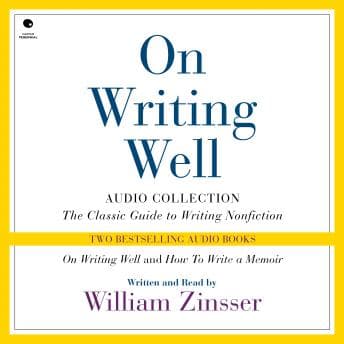

"Clutter is the disease of American writing." Zinsser drops this somewhere in the first twenty minutes, and I actually paused my 1.5x playback to let it sink in. Here I am, a person who writes incident reports and postmortems for a living, getting called out by a guy who taught at Yale in the '70s.
Bottom Line: Worth your commute—but with a major asterisk. This is basically a masterclass in clarity, but only for people who can tolerate some structural chaos.
The Professor You Wish You Had (And Sometimes Didn't)
Zinsser narrating his own work is both the best and weirdest choice here. Best because you're literally getting the man's cadence, his pauses, the way he emphasizes "simplify" like it's a religious commandment. Weird because—and I need to be honest—there's this faint condescension that creeps in occasionally. Like when your senior engineer explains something you already know, but slower.
The warmth is real though. Around the memoir section (roughly 90 minutes in), he talks about family history with this generosity that made me think about my own grandmother's stories. The guy genuinely wants you to write better. He's not flexing; he's teaching.
But here's the thing nobody warns you about: this is an abridged version. Originally recorded for cassette tapes. You'll occasionally hear cues about "flipping to side B" which is honestly kind of charming in a vintage way, but also means you're not getting the full 300-page experience. The ROI on this audiobook is good, but you're getting the highlight reel, not the director's cut.
Index Cards, Shuffled
I listened to this over two commutes—one morning, one evening—and by the second session I realized the organization is... scattered. Zinsser covers writing about science, then sports, then business, then memoir, and the transitions feel like he's shuffling index cards. Key points about word economy appear in the technology chapter, then resurface when he's talking about travel writing.
For a book about clarity, the audiobook structure is surprisingly messy. I found myself wishing I could Ctrl+F to the parts about simplifying sentences. (Software engineer brain, can't help it.)
The memoir section—the "new" 90-minute addition—is actually the most cohesive chunk. He walks through how Frank McCourt handled Angela's Ashes, how Annie Dillard approached personal history. Practical stuff. The kind of advice that makes you think "oh, I could actually do this."
Who Needs This in Their Ears
If you write anything—emails, documentation, that novel you've been "working on"—this is required listening. Zinsser's core message (cut the clutter, be yourself, rewrite obsessively) applies whether you're drafting a memoir or a Slack message to your skip-level. That same obsessive rewriting energy shows up in Leaders Eat Last, where Sinek keeps circling back to refine his central thesis about trust.
Skip this if: You need structured, sequential instruction. Or if you already own the print version and want the complete experience. The abridgment cuts muscle, not just fat.
At 2 hours 25 minutes, this is a single commute for me at 1.5x. Could've been a blog post? No, actually. This one earns its length—barely. The memoir section alone justifies the credit if you've ever thought about writing your own story.
Final Commit
Zinsser died in 2015, which means this recording is all we'll ever get of him teaching in his own voice. That matters. There's something irreplaceable about hearing an 80-something-year-old man talk about the craft he spent his life perfecting.
Is it perfect? No. The condescension creeps, the structure wobbles, and you're missing chunks of the original text. But the core lessons—write with humanity, murder your darlings, simplify until it hurts—those land. Hard.
I fixed a production bug at 3 AM last week and then rewrote the incident report three times because of this audiobook. Zinsser would be proud. Probably. He'd definitely tell me to cut this review by 30%.