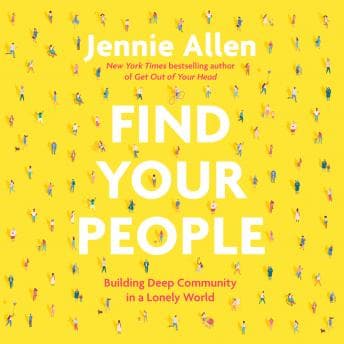
Jenny caught me listening to this one on a Sunday morning while I was making kimchi jjigae - my mom's recipe, the one she'd throw together after a 14-hour day at the shop like it was nothing. Jenny walked in, heard Jennie Allen talking about how we exhaust ourselves trying to prove our worth, and just gave me this look. The look that says "this is for you too, David." I pretended not to notice.
Bottom line: This is a 5-hour-52-minute book with about 2.5 hours of genuinely useful reframing for anyone who's built their identity around productivity and performance. The rest is repetition and biblical exposition that'll land differently depending on where you sit spiritually. For the right listener, it's a gut punch. For the wrong one, it's a long sermon.
The Hustle Gospel Gets a Counter-Argument
Here's what hit me: Allen's core thesis is that the striving - the constant proving, the performative competence - isn't just exhausting, it's actually a form of unbelief. You're saying "God's not enough, so I need to be." Now look, I'm a consultant. My entire career is built on proving value. My parents' entire lives were built on proving they belonged in this country through sheer, relentless work. So when Allen says "you have nothing to prove," my first instinct was to argue.
But she's not saying don't work hard. She's saying stop letting the work define whether you're enough. And that distinction - that tiny, razor-thin distinction - is where this book earns its keep. She talks about sitting with her own inadequacy as a leader of IF:Gathering, this massive women's movement she built, and admitting she couldn't sustain the image of having it all together. That specific vulnerability, where she describes the gap between leading a million-woman community and feeling like a fraud doing it, landed harder than most CEO memoirs I've reviewed.
Author-Narrated, and It Actually Works Here
Jennie Allen reads her own book, which in the business/self-help world is usually a disaster. Authors aren't narrators. They rush, they mumble, they sound like they're reading a legal deposition. Allen is different - not polished, not professional in the audiobook sense, but genuinely present. You can hear her voice catch when she talks about her struggles with approval. There's this raw, unguarded quality that a hired narrator couldn't replicate. She sounds like she's talking to you across a kitchen table, not performing for a studio mic. The closest I've come to that same unguarded, almost uncomfortably personal narration quality was in Man Up!: Tales of My Delusional Self-Confidence — different genre entirely, but the author reading their own vulnerability out loud hits the same nerve.
That said, the pacing is uneven. Some chapters feel like they're circling the same runway three or four times before landing. The message of "you're not enough but Jesus is" gets restated in slightly different packaging across multiple chapters, and at 2.0x speed I still found myself checking how much time was left around hour four. A tighter edit would've made this a knockout at 4 hours.
Who This Is Actually For (Honest Assessment)
This is explicitly a Christian book. Not "spiritual but not religious." Not "principles you can apply to any worldview." Allen is a Bible teacher, and she grounds every argument in scripture. If that's your framework, this will feel like drinking water after a long run. If it's not, you'll spend half the book translating her language into something you can use, and frankly, you'll lose patience.
For the faith-based audience though - especially women in leadership, women in ministry, women who've built their identity around being the capable one - this is pretty much exactly the right book at the right time. I've watched startup founders burn out because they couldn't separate their worth from their company's Series A. Heavenly Life circles this same exhaustion from a different angle — less confessional, but it asks the same uncomfortable question about what we're actually working toward. Allen is addressing the spiritual version of that same trap, and she does it with more honesty than most.
I'll say this: my mom never read a book like this. She just worked. Church on Sunday was her reset, not a self-help session. But watching her - and watching Allen describe the same exhaustion from a completely different context - I kept thinking they would've understood each other. Two women, decades apart, running on fumes and faith. My mom just didn't have the vocabulary Allen uses. She had the kimchi jjigae.
The Engagement Letter
At under six hours, the time investment is reasonable. The ROI depends entirely on whether you're in Allen's target audience. If you're a faith-driven person who's been white-knuckling your way through life trying to earn approval from God, people, or yourself - skip to this book, not chapter 5 this time, the whole thing. If you're outside that framework, the core insight about identity-driven exhaustion is universal, but you can probably get it from the first two hours and Brené Brown's back catalog.
Jenny would say I'm being harsh. Jenny is right. But Jenny also bookmarked three chapters for me to re-listen to, so make of that what you will.