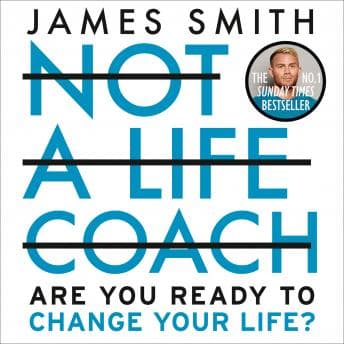

Okay, I need to rant for a second. If you're going to title your book Not a Life Coach, you should probably not spend six and a half hours doing exactly what a life coach does. The cognitive dissonance here is - honestly, it's a little fascinating from a psychological standpoint. James Smith positions himself as the anti-guru, the guy who'll give you "hard-hitting home truths" instead of platitudes, and then proceeds to deliver... motivational content that would feel right at home on a Pinterest board with a sunset background. I found myself asking: why does this framing bother me so much when the advice itself isn't terrible?
I was chopping onions for a chana masala when Smith started in on daily destructive habits - the small choices we make that compound into lives we didn't sign up for. And look, he's not wrong. The research actually shows that habitual behavior accounts for roughly 43% of our daily actions (that's a Duke University figure, not mine), so his instinct to focus on micro-decisions is psychologically sound. But there's a difference between identifying a real pattern and giving someone the tools to break it, and Smith tends to hover at the identification stage. He'll describe the problem with genuine passion and then offer solutions that feel like they were workshopped in a pub. "Just do the hard thing." Okay, James. My therapist would have thoughts about that approach.
The Personal Trainer Who Wants to Fix Your Soul
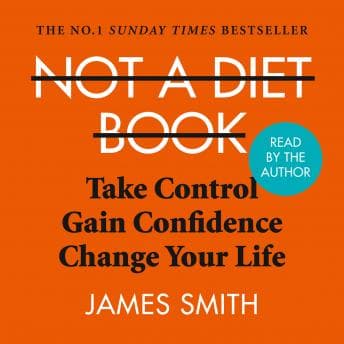
Here's what's interesting about Smith as a case study - and yes, I'm treating him as one, because he basically invites it by narrating his own book. He made his name as "the world's fastest-growing online personal trainer," and his first book, Not a Diet Book, apparently crushed it. So this is the pivot book. The one where a fitness guy decides he has things to say about success, relationships, fulfillment, the whole existential buffet. And you can hear in his voice that he genuinely believes what he's saying. His English accent carries this casual authority - like a mate at the pub who happens to have read one more self-help book than you have. It's charming. I get why people respond to it.
But charm is not depth. Smith describes daily destructive actions and challenges listeners to make better choices, and he does it with real energy. The problem is that when you strip away the delivery - the confident tone, the "I've been through it too" vulnerability - the content sometimes reads like a motivational Instagram caption stretched to chapter length. Some parts are genuinely oversimplified. He'll take a complex psychological concept like learned helplessness or identity formation and flatten it into a binary: you're either choosing growth or choosing comfort. Psychologically, this doesn't track. Human motivation is messier than that. We don't just "choose" to redefine our lives the way we choose between Netflix and the gym.
When the No-Nonsense Guy Actually Lands a Punch
I don't want to be entirely unfair, though. There are moments - and they tend to come when Smith stops performing the tough-love thing and gets genuinely personal - where he connects to something real. When he talks about his own life being "broken" and the kind of coach he needed but didn't have, you hear the armor drop. Those sections are the book at its most honest. He's not theorizing about human behavior; he's reporting from the wreckage of his own. That gap between performed wisdom and lived experience is something Single On Purpose also wrestles with — another pivot book from someone who rebuilt himself and decided the blueprint was worth sharing. And the no-nonsense delivery works better there because it feels earned rather than performed.
The author-narrated format helps here. Smith knows where his own emotional beats are, and he leans into them without overdoing it. At 6 hours and 44 minutes, it's a quick listen - almost too quick for the scope of what he's trying to cover (success, happiness, relationships, purpose, fulfillment - that's a lot of existential ground for under seven hours). The pacing moves fast, which keeps things engaging but also means nothing gets the depth it deserves.
Who Gets Something Out of This (And Who Won't)
If you're in your early twenties, feeling stuck, and you've never really interrogated your own assumptions about success - this might genuinely hit. Smith is good at asking the opening questions. Does your future excite you? Are your relationships working for you? Those are legitimate prompts for self-reflection. He's less good at sitting with the complexity of the answers.
If you've already done therapy, read Brené Brown or Mark Manson, or spent any time with actual psychology research on motivation and behavior change, you're going to find this pretty thin. Not useless - thin. Like a meal that fills you up for an hour and then you're hungry again.
I finished the last chapter while the masala was simmering, and I sat there thinking: this is a fascinating case study in the gap between intention and execution. Smith clearly wants to help people. He clearly cares. But wanting to help and knowing how to help are different skill sets, and this book lives in the space between them.
My Clinical Note
The protagonist exhibits classic helper-identity patterns - someone who rebuilt himself and now needs to prove the rebuilding was meaningful by offering the blueprint to others. That's not a criticism, exactly. It's just worth naming. Borrow this one if you need a motivational kick. Don't expect it to replace the harder, slower work of actually understanding yourself.