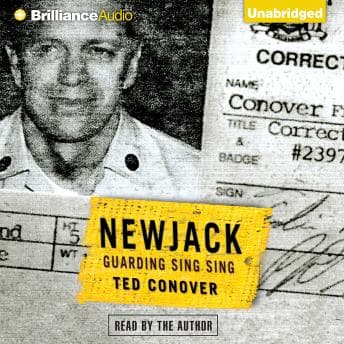

Ted Conover went undercover as a corrections officer at Sing Sing prison for a year, and the result is one of the most brutally honest pieces of immersive journalism I've ever listened to.
I came to this one sideways. My youngest had a stomach bug, and I was up anyway between shifts - not quite night shift energy, not quite mom energy, just that 2 AM limbo where you're awake and your brain needs something real to chew on. This was real.
The Institution Eats Everyone
What got me - what really got me - is how Conover captures the way an institution changes the people inside it. All of them. Guards, inmates, administrators. As someone who's actually worked in a system that grinds people down (hospitals and prisons have more in common than anyone wants to admit), I kept recognizing things. The dark humor that develops as a survival mechanism. The way fresh idealism curdles into something harder. The veteran staff who've stopped seeing the people they're supposed to serve as people. M. Scott Peck spends a lot of time on exactly that mechanism in People of the Lie — the gradual psychological architecture that lets people in institutional roles stop registering the humanity in front of them, and I kept thinking about his framework while Conover was describing his fellow officers.
Conover doesn't go in with some savior complex. He genuinely tries to be decent while also doing a job that sometimes requires you to strip-search a grown man or forcibly extract someone from their cell. The tension between those two things - wanting to be humane inside an inherently dehumanizing system - that's the beating heart of this book. And he doesn't pretend he figured it out. He didn't. Nobody does.
The history sections about Sing Sing's electric chair era and its evolution from a punishment-first institution are genuinely fascinating context, but I'll be honest - the pacing during those stretches and the corrections academy training chapters slows way down. Conover's narration loses its edge there, gets a little flat, like he's reading from notes instead of memory. You can tell the difference between the sections he lived viscerally and the sections he researched at a desk.
When the Author Reads Their Own Scars
Here's where it gets interesting with the author-narrated thing. When Conover is describing interactions with inmates - like his exchanges with Larson, or the escalating chaos of New Year's Eve on B-Block with actual flames and smoke - his voice changes. Gets tighter. More present. You can hear the adrenaline memory in his delivery, even years after the fact. That's something a professional narrator couldn't fake.
But it's a trade-off. A professional narrator would've kept the energy consistent through the slower material. Conover sometimes sounds like he's reading his own book for the first time, which is strange considering he wrote it and lived it. The training chapters especially felt like someone narrating a textbook they'd rather skip past to get to the good stuff. I get it - I feel the same way about charting versus actual patient care - but it does make for an uneven listen.
The production is clean, nothing fancy. No sound effects, no dramatic scoring. Just a man talking about a year that clearly marked him. For this kind of journalism, that stripped-down approach works. You don't need atmospheric prison sounds when Conover describes the smell and noise of B-Block with enough specificity that your brain fills it in.
This Is Not How Most People Think Prisons Work. Trust Me.
What surprised me most was how much of the book is about boredom. The grinding, soul-deadening monotony of standing a post for hours with nothing happening, punctuated by moments of genuine terror. Sound familiar? (Night shift nurses, I see you.) The critics who call this book slow are actually identifying its most honest quality - corrections work IS slow, and Conover doesn't dress it up.
Carlos asked why I was so quiet at breakfast. I didn't know how to explain that I'd just spent four hours listening to a man describe how a system designed to correct people mostly just breaks them, and how the people paid to run that system get broken too, and how nobody in charge seems to care much about either outcome. What do you say? "The audiobook was heavy, pass the rice."
This won the National Book Critics Circle Award and was a Pulitzer finalist, and for once the awards track with reality.
Who Needs This and Who Doesn't
If you want a fast-paced prison thriller - wrong book. If you want to understand what actually happens inside American prisons from someone who worked the galleries and survived to write about it with his conscience mostly intact, this is essential listening. Requires your actual attention though. This is not a background-while-grocery-shopping book. You need to be present for it, the way Conover was present for the year he spent behind those walls.
My mom would love this (she still thinks I should've been a doctor), but she'd also call me afterward to talk about the Filipino nurses she knows who work in prison healthcare systems. And then we'd both be quiet for a while.
Night Shift Approved - With a Caveat
Keep the speed at 1x. The slower sections tempt you to bump it up, but then a moment of real intensity hits and you need the full weight of Conover's delivery. Worth eleven hours of your time. Just maybe not eleven hours in a row.









