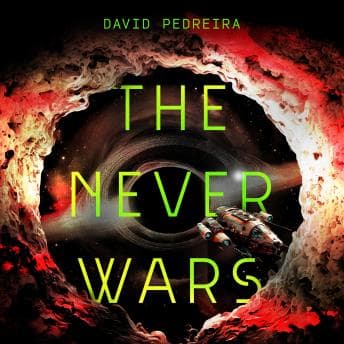

Bottom Line: "Time dilation as a military strategy" - I literally paused the audiobook and said this out loud on the Caltrain because the concept hit me so hard. Like, we've all read time dilation stories. Interstellar did it. A bunch of hard sci-fi has played with it. But using black holes to station armies in the future for Earth's dirty wars? That's a premise I hadn't encountered, and honestly, the science actually holds up way better than I expected.
So here's the deal with Never Wars: it's basically The Expanse meets Dirty Dozen, but with a time-travel mechanic that doesn't make you want to throw your phone across the train car trying to understand the logic. David Pedreira clearly did his homework on relativistic physics, and more importantly, he doesn't beat you over the head with it. The exposition comes naturally through the characters figuring things out themselves.
The Squad That Kept Me Awake Past My Stop
Owen Quarry and Anaya Pretorius anchor this thing, and thank god they're actually interesting. Military sci-fi can fall into the trap of making everyone a gruff stereotype with a callsign - you know the type. But Pedreira gives these soldiers actual interior lives. They're disgraced, they're desperate, and they're watching decades slip away on Earth while they barely age. The psychological weight of that? It creeps up on you.
The AI warship with "self-confidence issues" (yes, really) could've been a gimmick. It's not. There's something genuinely affecting about an artificial intelligence that's uncertain about its own purpose, especially when it's carrying a crew of humans who feel the same way. The dynamic between the AI and the soldiers reminded me of the ship-crew relationships in Becky Chambers' work, but grittier. That found-family vibe in a military context also shows up in Theft of Swords, though Pedreira's version trades the camaraderie for existential dread.
And look - I finished this in about 5 commutes. That's fast for me with an 11-hour book. The pacing drags slightly in the middle section when they're setting up the mission structure, but once the stakes become clear? I missed my stop. Twice.
John Pirhalla Nails the Ensemble
I hadn't listened to much from John Pirhalla before this, but he's got that versatile thing going where you actually forget it's one guy doing all the voices. His Quarry has this tired, seen-too-much quality that fits perfectly. Pretorius gets a distinct edge without veering into caricature. The accents are solid - we've got an international cast of soldiers and he handles the variety without any cringe moments.
The pacing of his delivery matches the book's rhythm well. When things get tense, he doesn't oversell it. When there's a quiet moment of existential dread (and there are several), he lets the silence breathe. Clean production, no weird audio artifacts - I could hear everything clearly even on a packed morning train with someone's phone alarm going off three rows back. (Yes, that happened. No, they didn't turn it off for a full minute.)
Where the Time-Bending Gets Heavy
Here's what I didn't expect: this book gutted me emotionally. The premise sounds like pure action - special forces, black holes, redemption missions. But Pedreira uses the time dilation to explore something darker. Every mission these soldiers complete, years pass on Earth. Decades. Everyone they knew ages and dies while they stay the same. The book doesn't shy away from what that does to a person.
There's a twist involving someone from their past that I genuinely didn't see coming. I won't spoil it, but it reframes the entire mission structure in a way that made me go back and re-listen to an earlier section. That's rare for me - I'm usually a one-and-done listener.
The violence is there, and it's not sanitized. These are soldiers doing ugly work. If you're sensitive to combat scenes, heads up. But it never feels gratuitous - it serves the story's larger point about what we ask people to sacrifice.
The ROI on This Audiobook
Perfect for: train, gym, any commute where you want your brain engaged but not overwhelmed. Skip if: you need something for bedtime listening (you'll stay up way too late) or you can't handle unsanitized combat scenes.
The science is accessible enough that you don't need a physics degree, but hard enough that it respects your intelligence. The characters earn their arcs. The narration elevates everything.
If you liked Gunpowder Moon (Pedreira's debut), this is a level up. If you haven't read him before, this is a solid entry point. And if you're a sucker for military sci-fi that actually has something to say about the cost of service? Yeah. This one's for you.
I'm already looking up what else John Pirhalla has narrated. That's the highest compliment I can give.