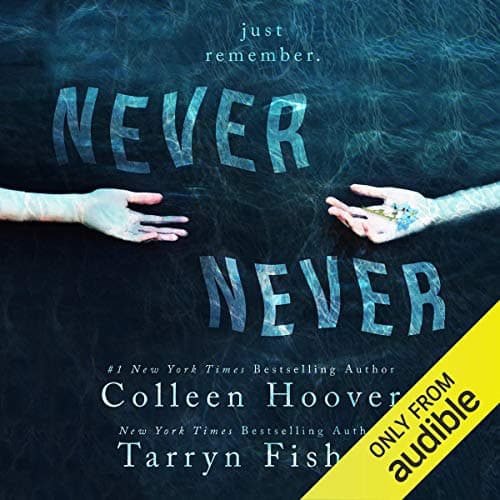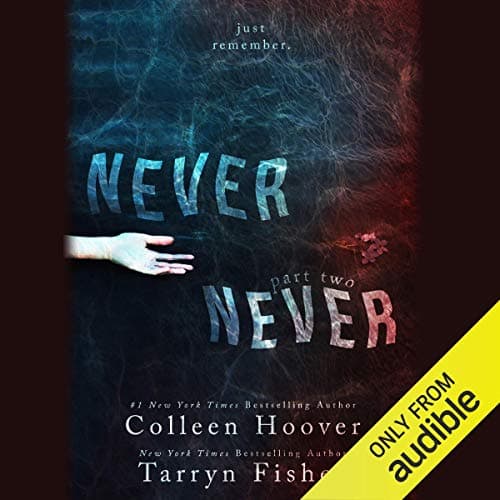

Two and a half hours. That's all you get with Never Never: Part Two, and honestly, it feels like Colleen Hoover and Tarryn Fisher handed you a sandwich with the middle missing.
Let me back up. I came into this sequel fresh off Part One, which left me dangling off a cliff with its wild premise — two teenagers who keep losing their memories with no explanation. The concept alone is enough to keep you hooked, and Part Two picks up right where things left off, with Silas desperately searching for Charlie while trying to piece together a past he can't remember. The mystery deepens here in genuinely interesting ways. New truths surface while existing threads get more tangled, and the stakes feel more urgent as suspicion from the outside world closes in on Silas.
The dual narration from Kevin Free and Elizabeth Evans continues to be the right structural choice for this story. Having distinct voices for Silas and Charlie's perspectives keeps the emotional temperature readable — you always know whose confusion and fear you're sitting inside. Evans brings a vulnerability to Charlie that works well against Free's increasingly frantic Silas. When the story hits its emotional beats — the "never nevers" and the ache of loving someone you technically just met — both narrators sell it. Evans in particular has a way of making Charlie's disorientation feel real rather than repetitive.
That said, Free's voice work for secondary characters drew some mixed reactions, and I can see why. His female character voices can pull you out of the moment. It's not a dealbreaker, but in a story this short where every minute counts, those small friction points matter more than they would in a ten-hour listen.
And that's the central tension of this audiobook: the brevity. At roughly half the length of Part One, Part Two feels like it's hitting its stride right as it ends. The pacing moves quickly — almost too quickly — through revelations that deserve more room to breathe. You're getting genuine plot development here, real forward momentum on the mystery, and some unexpected twists that reframe what you thought you knew. But just as you lean in, you hit another cliffhanger. If Part One's cliffhanger was a hook, Part Two's is more like a shove.
This is clearly a serialized story designed to be consumed across all three parts, and Part Two makes the least sense as a standalone experience. It's the bridge episode, the middle act, and it does its job — the mystery is legitimately intriguing, the relationship between Silas and Charlie evolves in ways that feel earned even within the amnesia framework, and the writing partnership between Hoover and Fisher produces a voice that's sharper and more suspenseful than either typically writes alone.
The unique concept remains the star. There's something genuinely unsettling about two people falling in love with someone they're supposed to already love, all while the clock ticks toward another memory wipe. That same ache of loving someone across a fractured timeline runs through Commonwealth too, though Ann Patchett stretches it across decades rather than amnesia cycles. The romance doesn't rely on typical tropes here; it's built on the terrifying premise that everything you feel could vanish. That gives even the tender moments an undercurrent of dread that kept me engaged despite the short runtime.
For the listening experience, this demands your attention. It's not a background-while-doing-dishes kind of listen. The plot twists land on details — a discovered note, a shifted timeline, a reaction from someone who knows more than they're saying — and you'll miss the threads if you're not tracking closely. The good news is that at two and a half hours, you can knock this out in a single focused session.
Here's my honest take: if you've already listened to Part One, you're going to listen to this regardless of what I say. The mystery has its hooks in you. And you should — Part Two delivers enough intrigue and enough emotional payoff between Silas and Charlie to justify the ride. But go in knowing this is an appetizer, not an entrée. You'll finish it wanting more, and whether that frustrates you or thrills you probably depends on whether Part Three is already in your library.
The production is clean and straightforward — no sound effects or musical flourishes, just two solid narrators trading chapters. For a story this reliant on atmosphere, the narrators carry a heavier load than usual, and they mostly handle it well. The emotional delivery matches the escalating tension, even if the experience ends before it should.
Who should listen: If you finished Part One and the mystery already has its claws in you, just keep going — Part Two rewards that investment. Skip this if you need stories that stand on their own or if paying full credit for two and a half hours makes your eye twitch. Grab it on sale or through a subscription service if you can. The story deserves your time — it just doesn't quite justify the premium.