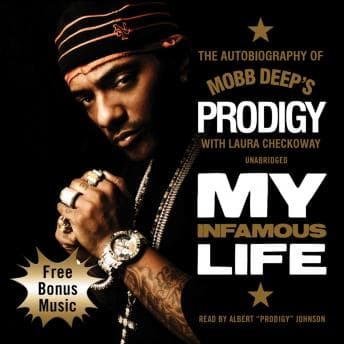
Slate called this audiobook "the best rap album of the year" when it dropped. I wouldn't go that far. But I will say this: sitting in my home office at 1 AM on a Tuesday, supposedly prepping a pitch deck for a fintech client, I found myself four hours deep into Prodigy's life story with zero work done. That's either high praise or a billing problem.
Bottom line: This is a messy, overlong, occasionally brilliant memoir that accidentally contains more real business insight than half the startup books cluttering my Audible library. My 2.0x speed couldn't save the bloated middle chapters, but the story underneath? Worth the excavation.
From Private School to Queensbridge - The Pivot Nobody Teaches at HBS
Here's what grabbed me. Prodigy wasn't born in the projects. He grew up around Diana Ross and Dizzy Gillespie. Private schools. A family with legitimate musical pedigree. Then family tragedy hits and he's in Queensbridge Houses, one of the roughest public housing projects in New York. That pivot - from privilege to survival mode - is something I've never seen covered honestly in a memoir like this.
Most rags-to-riches stories start at the rags. Prodigy's starts at the riches, falls to the rags, climbs back to different riches, then crashes again. It's a more complicated arc, and he doesn't simplify it for you. His descriptions of managing sickle cell anemia while recording albums and running the streets - the kid was literally having pain crises in the studio. Hospitalizations between sessions. That's not hustle culture Instagram nonsense. This is what my parents did instinctively. Now it has a TED talk. Except Prodigy's version involves way more guns and way less dry cleaning.
The Music Industry as a Case Study in Getting Robbed
The sections on the business side of hip-hop are where I perked up. Prodigy walks through deal after deal - the Loud Records relationship, the management dynamics, the money that disappeared into other people's pockets. His accounts of interactions with Puff Daddy, Russell Simmons, Lyor Cohen, Chris Lighty, Irv Gotti - these aren't name drops. They're case studies in how creative talent gets systematically separated from revenue.
I've seen this fail at three different companies. The pattern is identical whether you're a rapper in 1995 or a technical founder in 2024: the person who creates the value rarely captures it, because they don't understand the contracts they're signing while they're too busy creating. Prodigy gets this, and his bitterness about it feels earned, not performative.
I've seen the same dynamic of value creators getting chewed up by their industries explored from the other side of the table in Impostora: Yellowface, a razor-sharp novel about who gets to tell stories and who gets paid for them.The Jay-Z beef sections are surprisingly instructive too. Not for the drama - though there's plenty - but for how Prodigy describes the strategic calculations behind public feuds. Who benefits. Who loses. How perceived loyalty to Nas went unreciprocated. There's a moment where his disappointment in that broken loyalty comes through in his voice so clearly that I actually paused the audiobook. The man is narrating his own story and you can hear the exact second he's reliving the betrayal. That's something no professional narrator could replicate.
Prodigy Behind the Mic - Authentic but Unpolished
And that's the tension with the narration. Prodigy reading his own memoir is both the biggest strength and the most frustrating limitation of this audiobook. His Queensbridge accent is the real thing - no smoothing, no radio voice. When he describes the street-level chaos of early '90s Queens, the delivery matches the content perfectly. You believe every word because the man who lived it is telling you directly.
But - and Jenny would say I'm being harsh, Jenny is right - it's also 13 hours and 50 minutes of a single voice with no production flourishes, no music breaks, no chapter transitions beyond the next track starting. For a story rooted in music, the audiobook is weirdly silent. No Mobb Deep beats. No "Shook Ones" instrumental underneath. Just Prodigy talking. Given the raw material, some production ambition would've elevated this significantly.
The pacing sags hard in the middle third. There are stretches - probably hours 5 through 8 - where the chronology gets loose and the beefs blur together. Skip to chapter 5. Thank me later. Actually, don't skip - but maybe bump to 1.5x for those middle chapters and slow back down when the prison narrative kicks in.
Who Gets an ROI on 14 Hours
If you lived through '90s hip-hop, this is essential listening. Period. If you're interested in how the music industry actually works behind the mythology - the broken deals, the loyalty economics, the way fame metabolizes people - there's genuine value here that most business books are too sanitized to deliver.
If you have zero connection to hip-hop and you're looking for a tight, efficiently structured memoir? This isn't it. The editing could've been 30% tighter and the book would've been 40% better. That math doesn't lie.
Knowing that Prodigy died in 2017 - choking on an egg at 42, sickle cell complications - gives the whole thing a weight that's hard to shake. The man spent his life fighting his own body, the music industry, the streets, and the justice system. He recorded this before he knew it would become his final extended statement. You can't unhear that once you know it.