
Everyone keeps comparing this to Who Moved My Cheese? and Fish!, and honestly? That's the most accurate comp I've ever seen on a book jacket. Not because it's as good as either of those — but because it occupies the exact same niche: business parable you can absorb in one sitting, retain maybe 40% of, and feel vaguely motivated by for approximately 72 hours.
I knocked this out on a single round-trip commute. Four hours. 1.75x speed. And I'm being generous calling it four hours of content — there's maybe a solid blog post's worth of original insight here, stretched across chapters with the kind of repetition that makes you wonder if the editor was on vacation.
The Bus Metaphor Does Exactly One Thing Well
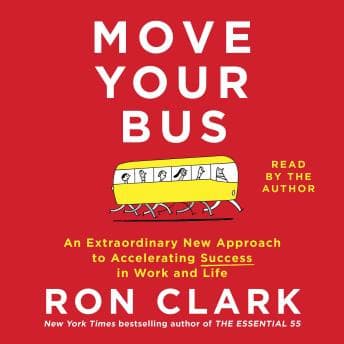
Here's the framework: your organization is a bus. People on the bus fall into five categories — Drivers, Runners, Joggers, Walkers, and Riders. Drivers steer. Runners sprint alongside pushing it forward. Joggers do their jobs but won't break a sweat. Walkers barely contribute. Riders? Dead weight. Your job as a leader is to spend your energy on the Runners, not waste it dragging Riders along.
That's... it. That's the book. And look, the metaphor is clean. I'll give it that. It's the kind of thing that sticks in your head during a 1:1 with your manager when you're trying to explain why half the team is carrying the other half. I've literally already used "Runner vs. Rider" in a Slack message to Kevin about our on-call rotation. So the ROI on the mental model is real, even if the book surrounding it is 80% filler.
Ron Clark comes from education — he's the guy who founded the Ron Clark Academy in Atlanta, Disney's American Teacher of the Year, Oprah's Phenomenal Man pick. And you can feel the classroom energy in how he structures the book. Each category gets its own section with examples that feel very... motivational-speaker-at-a-corporate-retreat. Lots of "I once worked with a teacher who..." and "imagine if your top performer..." scenarios that are fine but never surprised me once.
Author-Narrated: The Charm Tax
Clark narrates this himself, and here's where my software-engineer brain and my audiobook-snob brain are in conflict. He's genuinely enthusiastic. You can tell he's a guy who commands a room — his pacing is good, his energy is consistent, and he clearly believes every word he's saying. That authenticity counts for something.
But he's not a professional narrator. There's a flatness to the delivery during the longer explanatory sections where someone like — okay fine, not every book needs Ray Porter, but even a mid-tier business narrator would've added some dynamic range. Clark reads it the way a TED speaker would deliver it: high energy, punchy, but ultimately one gear. For four hours, one gear is fine. For anything longer, it'd be a problem.
The production is clean — no weird audio artifacts, no background hum (I'm looking at you, every self-published audiobook I've accidentally bought). Just Clark, a mic, and relentless optimism.
The "Could've Been a Blog Post" Calculus
I keep a mental spreadsheet of insight-per-hour for business audiobooks. This one clocks in at maybe 0.5 genuinely useful ideas per hour. The bus categorization framework? Great. The advice on how to identify Runners and protect them from burnout? Solid — and actually relevant to anyone managing an engineering team where your top ICs are getting crushed while Walkers coast on their coattails. The stuff about when to fire Riders? Necessary but surface-level.
What's missing is depth. Clark tells you to "recognize your Runners" but doesn't really grapple with the hard version of this: what happens when your Runner is also kind of a jerk? What about the Jogger who used to be a Runner but got burned out because leadership kept piling on? There's a systems-thinking layer completely absent here. It's all individual categorization, no root cause analysis. As someone who debugs distributed systems for a living, that drives me a little nuts — you're treating symptoms, not the architecture.
Who Should Grab This (and Who Should Just Read the Summary)
Perfect for: first-time managers, team leads who've never thought about team dynamics formally, anyone who needs a shared vocabulary for "why is this person on the team." Also genuinely good for education folks — Clark's background shines brightest when he's drawing from classroom examples.
Skip for: anyone who's read more than two management books. If you've already done Radical Candor, The Manager's Path, or even The Five Dysfunctions of a Team, this will feel like Management 101 review. The kind of depth that's actually missing here shows up in something like Amazon Unbound — that book does the hard work of showing how organizational dynamics actually play out at scale, not just categorizing people on a bus.
Perfect for: train, gym, doing dishes. Skip for: anything requiring your full attention — you'd be wasting it.
The Commute Verdict
TL;DR: The bus metaphor will live rent-free in your head. The other three hours and fifty minutes... not so much. Could've been a blog post. A really good blog post, but a blog post. I don't regret the commute — I had to get to Mountain View anyway — but I wouldn't spend a credit on it when it's probably streaming free on your library app.