
How many times can someone tell you "exercise is good for your brain" before it actually sticks?
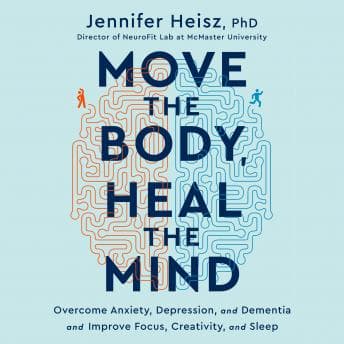
Because I've heard it approximately eight thousand times — from podcasts, from Kevin, from my own mother who sends me articles about walking and dementia prevention like it's a religion. But Jennifer Heisz's Move the Body, Heal the Mind hit different, and I think it's because she's not just telling you to exercise. She's showing you the actual neural machinery behind why a 20-minute HIIT session does more for treatment-resistant depression than upping your SSRI dose. And she does it while weaving in her own fitness story, which — credit where it's due — keeps this from feeling like a textbook.
I finished this across two commutes and a Saturday morning where I was too lazy to actually go to the gym, which felt appropriately ironic.
The Part Where a Neuroscientist Made Me Feel Guilty About Skipping Leg Day
The core thesis is straightforward: physical inactivity is as significant a risk factor for cognitive decline and mental illness as genetics. That's a big claim, and Heisz backs it with research from her lab at McMaster University and the broader neuroscience literature. She breaks the book into condition-specific chapters — anxiety, depression, dementia, ADHD, sleep, creativity — and each one walks through the mechanisms. Not just "exercise releases endorphins, yay" but actual pathways. The anti-inflammatory effects of exercise on depression, specifically for people who don't respond to antidepressants, was the section that made me sit up (well, sit up straighter in my Caltrain seat). She explains how chronic inflammation in the brain blocks serotonin production and how exercise essentially acts as an anti-inflammatory intervention. That's not hand-wavy wellness talk. The science actually holds up.
She also gets into lactate thresholds and interval training protocols for anxiety — basically, training your body to tolerate higher levels of physical stress so your panic response recalibrates. This is basically exposure therapy but for your cardiovascular system. I found that genuinely useful as a framework.
The workout plans at the end are... fine? There's a supplemental PDF, which is basically useless in audio format. If you're listening, you'll want to grab the PDF separately. This is a known limitation of fitness-adjacent audiobooks and I wish publishers would just acknowledge it upfront instead of slapping "PDF included" on the listing like that solves the problem.
Author-Narrated: The Double-Edged Sword
Heisz narrates her own book, and honestly? She's better than most author-narrators. Her delivery is clear, her pacing is steady, and she doesn't do that thing where academics read their own sentences like they're encountering them for the first time. She sounds like someone giving a really good lecture — engaged, conversational, occasionally personal. When she talks about her own struggles with anxiety and her journey from sedentary grad student to competitive triathlete, there's a genuine warmth that a hired narrator probably couldn't replicate.
That said, she's not Ray Porter. (But who is.) There's a flatness to the emotional register that means longer stretches of data-heavy content can blur together, especially at 6 AM. I bumped this to 1.5x and it felt right — her natural pace is a touch slow for the density of the material. At 1.75x it gets clipped in a distracting way, so stick with 1.5x.
The "Could've Been a Blog Post" Meter
At 6 hours 19 minutes, this is lean. And I respect that. Heisz doesn't pad. She doesn't spend three chapters on her childhood or dedicate forty minutes to thanking her research assistants. But — and this is a real but — the book sometimes reads like a well-organized literature review with personal anecdotes stapled between sections. The practical takeaways per chapter can feel thin relative to the research summaries. You'll walk away understanding why exercise helps your brain, but the how to actually build sustainable habits part gets less airtime than I wanted. Atomic Habits does the habit-building legwork that Heisz largely skips — if you finish this book fired up but uncertain how to actually wire exercise into your routine, that's the pairing I'd reach for.
Compare this to something like Spark by John Ratey, which covers similar territory with more storytelling punch, or Exercised by Daniel Lieberman, which goes deeper on the evolutionary angle. Heisz's contribution is the personal thread and the clinical specificity — she's more precise about which types of exercise map to which conditions. That's her value-add, and it's legitimate.
The ROI Check
The ROI on this audiobook is solid if you're the type of person who needs the scientific receipts before you'll commit to a behavior change. If you already exercise regularly and just want motivation, this might feel redundant. If you're dealing with anxiety or depression and want to understand the biological case for movement as intervention — not replacement for treatment, but a genuine tool in the stack — this delivers.
Perfect for: commute, gym (meta, I know), walking. Skip for: bedtime — it's too informational, your brain won't wind down.
Who should listen: Anyone who's ever Googled "does exercise actually help anxiety" at 1 AM. Engineers who need to see the data before they'll change a variable. People whose therapists have suggested exercise and who responded with skepticism. If you're already a Huberman devotee who's optimized your zone 2 cardio, you probably know 70% of this already.
I gave this a nudge on my next-morning run. Which I guess means it worked.