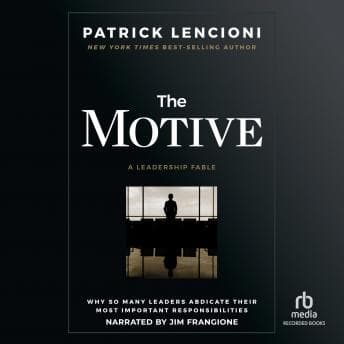

"You're doing it for yourself."
That line hit me somewhere around minute twenty, and I was standing in my kitchen with a half-chopped onion and a knife frozen mid-air. Because here's the thing about Lencioni — he writes business fables that read like therapy sessions, and this one felt like it was looking directly at me. Not because I'm a CEO. I'm an academic, which means I lead approximately nobody except my overworked research assistant. But the psychological framework here? The protagonist exhibits classic self-deception patterns that show up everywhere — in boardrooms, in faculty meetings, in marriages.
Two CEOs Walk Into a Confrontation
The setup is deceptively simple. Shay Davis, CEO of Golden Gate Alarm, is floundering a year into his role. He's forced into a day-long conversation with Liam Alcott, the CEO of a rival company and basically the last person on earth Shay wants advice from. What makes this character dynamic compelling is that Lencioni doesn't give us a mentor-mentee relationship. He gives us adversaries. Liam isn't gentle. He's blunt to the point of cruelty, telling Shay straight up that his leadership is self-serving — and Shay's defensiveness is so realistic it's almost uncomfortable.
I found myself asking: why does Shay agree to keep listening? That's where the psychology gets interesting. Lencioni understands that people don't change because someone gives them good advice. They change because the pain of staying the same becomes unbearable. Shay's desperation overrides his ego, barely, and that tension carries the entire fable. That particular psychological mechanism — ego as the last wall before genuine change — is something John Kim maps onto personal identity in Single On Purpose, though his lens is romantic relationships rather than boardrooms, the self-deception patterns he describes are uncomfortably familiar.
Compared to Lencioni's other work — The Five Dysfunctions of a Team, The Ideal Team Player — this one is leaner. Almost aggressively so. At 2 hours and 38 minutes, it's practically a pamphlet by audiobook standards. But the research actually shows that shorter interventions can be more impactful when they target a single behavior change, and that's exactly what Lencioni does here. One idea: are you leading because you want to serve, or because you wanted the title? He just hammers that question from every angle.
The Fable Problem (And Why It Mostly Works Here)
Look, business fables are a weird genre. They're basically case studies wearing a fiction costume, and the dialogue can feel wooden because the characters exist to illustrate a framework, not to be actual humans. Lencioni's dialogue is crisper than most — the Shay-Liam confrontation has genuine friction — but there are moments where the lessons land a little too neatly. Real people don't have epiphanies in such clean sequences. My therapist would have thoughts about how quickly Shay's defenses come down in the second half.
But psychologically, the core concept does track. Lencioni distinguishes between reward-centered leaders (I took this job because it validates me) and responsibility-centered leaders (I took this job because there's work that needs doing). That binary is oversimplified — motivation is always messier than two categories — but as a diagnostic tool? It's genuinely useful. I caught myself mentally sorting every department chair I've ever worked under.
The second half shifts from fable to framework, which is standard Lencioni. He lays out five specific areas where reward-centered leaders fail: avoiding difficult conversations, not managing their direct reports, skipping boring meetings, not building a real leadership team, and failing to repeat key messages. None of this is revolutionary on its own, but the fable gives it emotional weight. You're not just reading a list. You're thinking about Shay's face when Liam tells him the hard truth.
Jim Frangione Keeps It Clean
Frangione's narration is solid — professional, clear, no distracting tics. He won an AudioFile award for mystery narration, and you can hear that precision here. The dialogue between Shay and Liam has enough vocal distinction that you always know who's talking, even though we're basically just toggling between two men in a room. It's not a performance that'll blow your hair back, but for a short business fable, it's exactly what you need. No ego in the narration, which — given the book's thesis about ego in leadership — feels kind of perfect.
Who Should Spend Two and a Half Hours Here
If you manage people and you've never stopped to honestly ask yourself why you wanted the job — listen to this. If you're in a leadership role and you find yourself avoiding the tedious, unglamorous parts (the one-on-ones, the repetitive messaging, the meetings about meetings), this book is basically calling you out by name. It's short enough to finish in a single commute or — in my case — one elaborate biryani that I'll be eating for the next four days.
If you want deep psychological complexity or a business book with real narrative ambition, this isn't it. Lencioni trades depth for clarity, and that's a deliberate choice. I wanted more from Shay as a character. I wanted to understand his childhood, his patterns, what made him a reward-centered leader in the first place. But that's the researcher in me talking. The book isn't trying to be a character study. It's trying to change one specific behavior in its reader.
The Diagnosis
This is a fascinating case study in how simplicity can be a feature, not a bug. Lencioni identified a single psychological pattern — the self-serving leader who doesn't realize they're self-serving — and built a sharp, fast intervention around it. Is it his best book? Probably not. Is it the one most likely to make a mediocre manager pause and think? Maybe. And at under three hours, the cost of finding out is basically nothing.