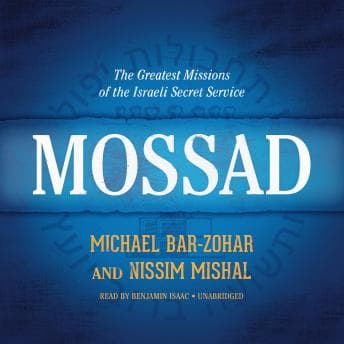

What does it take to build the most feared intelligence agency on the planet from scratch - in a country smaller than New Jersey? That's the question that kept me glued to this one during a week of late-night security audits for a client in Houston. Ranger was asleep on his bed by hour two, but I was wide awake, coffee in hand, running through fourteen-plus hours of operations that range from the audacious to the borderline insane.
Let me cut to the chase: Mossad by Bar-Zohar and Mishal is a solid operational history. Not perfect, but worth your time if you have any interest in how a small nation punches way above its weight in the intelligence world.
Sixty Years of "Did They Really Just Do That?"
The book is structured as a series of mission accounts spanning Mossad's history, and some of these operations are genuinely jaw-dropping. The Eichmann capture in Buenos Aires - agents physically grabbing a Nazi war criminal off a street in Argentina and flying him back to Israel - gets the treatment it deserves. But the chapters I found most gripping were the ones I knew less about. Elie Cohen's years-long infiltration of the Syrian government, where he rose high enough in Damascus social circles to influence military decisions, reads like something a thriller novelist would get rejected for pitching because it's too unbelievable. The man was literally touring Syrian fortifications on the Golan Heights with military officials, feeding everything back to Tel Aviv.
The Entebbe raid gets a full accounting too, and here's where Bar-Zohar's background as Ben-Gurion's official biographer shows - he understands the political machinery behind the military decisions. You get the cabinet debates, the logistical nightmares of flying C-130s to Uganda, the split-second decisions on the ground. The Al-Mahbhouh assassination in Dubai, with its forensic reconstruction of how a Mossad team used forged passports and hotel room access to eliminate a Hamas arms dealer, is practically a how-to manual for operational planning.
I've seen some of these scenarios play out in real life - not at this level, but the principles of compartmentalized ops, cover identities, and extraction planning are universal. The authors clearly did their homework on the operational details, and as someone who's planned a few missions myself (considerably less glamorous ones), I appreciated that they got the fundamentals right.
The Report Card Problem
Here's where it lost me in stretches. Some listeners have called this more of a report than a story, and I can see that. The book covers so many operations - we're talking decades of history across thirty-something chapters - that individual missions sometimes get the Wikipedia treatment. You'll be deep into a fascinating operation and suddenly the chapter ends and you're dropped into an entirely different decade with new characters. There's no real connective tissue between missions beyond "Mossad did this next."
At 14 hours and 37 minutes, the book is substantial, but it's spread thin. I would've traded five operations for deeper coverage of ten. The Vanunu capture (the nuclear technician who leaked Israel's nuclear secrets to the press) deserved more than what felt like a brisk summary. When you're dealing with a honey trap operation that lured a man from London to Rome to be drugged and shipped to Israel, I want the granular details - the surveillance logs, the internal debates, the near-misses.
Bar-Zohar and Mishal are journalists at heart, and it shows. Clean, factual prose. Not much flair. Which is fine for a briefing, less fine for a fourteen-hour listen when you need narrative momentum to carry you through.
Benjamin Isaac Behind the Mic
Benjamin Isaac delivers a steady, professional narration. No complaints about clarity or pacing. He handles the Hebrew and Arabic names competently - didn't catch any obvious butchering, which matters when you're dealing with dozens of Israeli and Middle Eastern figures. But "steady and professional" is about as exciting as I can make it sound. There's no real dramatic range here. When he's reading about a Mossad agent seconds from being discovered in an enemy capital, it sounds roughly the same as when he's covering bureaucratic reshuffling in Tel Aviv. For a book that already leans toward the clinical, a narrator with more intensity in the action sequences would've elevated the whole experience.
I ran it at my standard 1.25x and it worked fine. Isaac's pace is measured enough that the bump doesn't lose anything.
Who Gets This Brief
If you're an intelligence history junkie or you want a broad survey of Mossad's greatest hits - literally - this delivers. It's a buffet, not a five-course meal. Corporate security folks on my team would get value from the operational planning details. Thriller readers looking for real-world inspiration will find plenty here.
But if you want deep character studies or the kind of narrative tension that makes you miss your highway exit, manage your expectations. This is a well-researched encyclopedia of operations, not a spy novel.
Worth your time? Here's the debrief: grab it on sale, queue it up for a long drive or a week of windshield time. It won't change your life, but you'll come away knowing things about covert operations that most people never will. And a few of those missions - Cohen in Syria, the Entebbe rescue - will stick with you. Ranger slept through most of it, but he perked up during the action sequences. Good enough for me. The Cohen and Entebbe chapters left me with that same unsettled, can't-quite-shake-it feeling I had finishing Five Little Indians — stories where the human cost of larger historical forces never quite lets you go.