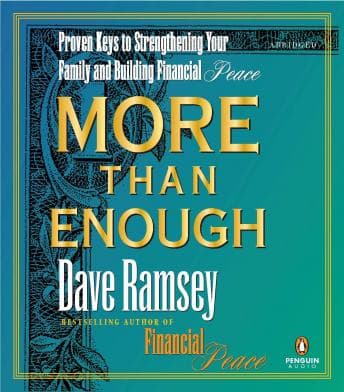

I was making dal tadka at 10 PM on a Tuesday — the kind of elaborate weeknight cooking that signals either ambition or avoidance of my own manuscript — when Dave Ramsey started preaching at me through my kitchen speakers. Two hours later, the dal was perfect and I had... thoughts.
Here's the thing. I study why people do what they do with money, relationships, power. And Ramsey's framework in More Than Enough is genuinely interesting from a behavioral psychology perspective, even when the execution made me want to throw a wooden spoon at my Bluetooth speaker.
The Preacher-Therapist Hybrid Nobody Asked For (But Some People Need)
Ramsey reads his own book, and his delivery is exactly what you'd expect if you've ever heard his radio show — folksy Southern cadence, the rhythm of a tent revival speaker who also happens to know what a mutual fund is. There's a pithy, punchy quality to how he lands his points. He'll build up a story about a couple drowning in credit card debt, then drop a one-liner about discipline that hits like a proverb your grandfather would cross-stitch onto a pillow.
Psychologically, this doesn't track as traditional self-help narration. It's closer to motivational speaking captured on tape. And that's both its strength and its limitation. When Ramsey talks about how values drive financial behavior — not spreadsheets, not math, but the stories we tell ourselves about what money means — he's actually touching on narrative identity theory without knowing it. The research actually shows that our financial decisions are deeply tied to the identity scripts we inherited from our families. Ramsey gets this intuitively, even if he'd never cite Bruner or McAdams.
But the ten keys he outlines (values, goals, patience, discipline, giving back, etc.) are delivered with the confidence of someone who believes repetition equals revelation. By the time he circled back to "discipline" for what felt like the fourth time in a two-hour audiobook, I found myself asking: why does Ramsey really think hearing the same principle repackaged with a different anecdote constitutes a new chapter?
When the Case Studies Do the Heavy Lifting
The strongest moments are the stories. Ramsey draws from his work with thousands of families, and the couples and single parents he describes become these miniature case studies in financial psychology. There's something genuinely affecting about hearing him narrate the arc of someone who went from financial chaos to stability — not because the advice is revolutionary, but because the emotional pattern is recognizable. The protagonist in each story exhibits classic learned helplessness before the intervention, then a gradual shift toward internal locus of control.
That's compelling stuff. My therapist would have thoughts about how many of these financial crises are actually attachment crises in disguise — people spending to fill emotional voids, couples fighting about money when they're really fighting about trust and control. Ramsey hints at this connection between finances and romance, which is probably the most psychologically honest section of the book. He doesn't go deep enough for my taste (I wanted him to really sit in the discomfort of why money destroys marriages), but he acknowledges the territory.
The Bible quotations and worksheets — look, I grew up in a Hindu household watching Bollywood films where dharma and destiny drove every plot. I can respect a moral framework even when it's not mine. But listeners who aren't coming from a Christian perspective should know this book leans heavily into that worldview. It's not a dealbreaker, but it's definitely the lens.
Two Hours Is Either Perfect or a Problem
At two hours, this is basically a long podcast episode. And that framing actually helps. If you approach More Than Enough as a concentrated pep talk with some actionable frameworks — budgeting basics, the debt snowball concept expanded from Financial Peace, retirement planning principles — it delivers. If you're expecting the depth of a proper financial psychology text, you'll be hungry afterward.
The single-narrator, author-read format works for this specific book because Ramsey's whole brand IS his voice. You're not buying analysis; you're buying conviction. And he sells conviction like nobody's business.
Speed recommendation: 1.25x. Ramsey's pacing is deliberate — preacher cadence means dramatic pauses — and bumping it up keeps the energy from dipping during the more repetitive stretches.
Who Gets the Most Out of This
If you're early in your financial literacy journey and you respond to storytelling over spreadsheets, this is a solid starting point. If you've already read Financial Peace or listened to Ramsey's show extensively, you'll recognize a lot of recycled material and might feel shortchanged. If you're a behavioral psychology nerd like me, you'll find yourself annotating the interesting bits and getting frustrated that he doesn't push further into WHY people self-sabotage financially.
Single parents and couples in financial conflict — honestly, those are the listeners who might find the most value here. Not because the advice is groundbreaking, but because hearing someone say "you're not broken, you just need a plan" in that warm, certain voice can be the permission slip some people need.
The Diagnosis
This is a fascinating case study in how delivery can elevate fairly standard financial advice into something that feels personal. Ramsey understands human nature — specifically, he understands that most people don't fail with money because they're bad at math. They fail because of fear, shame, and stories they inherited. He just doesn't explore that insight as deeply as I wish he would. Essentialism scratches that itch more rigorously — McKeown actually digs into the psychological cost of saying yes to everything, including debt and lifestyle inflation, in a way that Ramsey gestures at but never commits to. Two hours of folksy wisdom, some genuinely moving family stories, and a framework that's simple enough to actually use. Not groundbreaking. But for the right listener at the right moment? Potentially the nudge that changes everything.