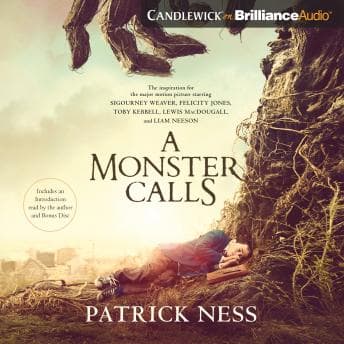

I was chopping onions for a dal when Jason Isaacs made me cry, and I'm still not sure which one to blame.
Look, I knew what I was getting into. A book about a boy whose mother is dying of cancer, with a monster that shows up at midnight demanding truth? This is a fascinating case study in how we use fantasy to process the unprocessable. My therapist would have thoughts about this entire premise. But knowing something intellectually and having it gut-punch you while you're standing in your kitchen are two very different things.
The Monster as Therapist (Stay With Me Here)
What makes this work is that the monster isn't really the antagonist. Conor is thirteen, his mother is in treatment, his grandmother is cold and terrifying in that very British way, and his father has basically checked out to start a new family in America. Classic avoidance patterns everywhere—he's waiting for a nightmare, but not this nightmare. The monster that actually shows up wants something far worse than fear. It wants honesty.
Patrick Ness understands human nature in a way that makes my researcher heart sing. The three stories the monster tells Conor aren't simple morality tales. They're messy. The good guy does terrible things. The villain isn't always wrong. And Conor keeps waiting for the lesson, the neat psychological bow, and it never comes. Sing, Unburied, Sing operates on this same principle—grief as something that refuses to be contained or categorized, that shows up in unexpected ways and won't let you look away. Because grief doesn't work that way. (I found myself asking: why does Conor really keep getting into fights at school? The answer, when it comes, is devastating.)
The research actually shows that children often experience anticipatory grief very differently than adults—they oscillate between denial and hyperawareness in ways that can look like behavioral problems. Ness captures this perfectly. Conor isn't a precocious sad boy. He's angry. He's destructive. He wants to be punished because punishment would mean someone is paying attention to him instead of to his mother's illness.
Psychologically, this tracks completely.
Why Jason Isaacs Works
I'd listened to Isaacs in other things before, but this performance is something else entirely. His monster voice is ancient and wild—deep, gravelly, the kind of voice that sounds like it's coming from inside the earth. But here's the thing: he doesn't make it scary in the obvious way. He makes it inevitable. Like the truth Conor is running from.
And then he switches to Conor, and you get this boy who's trying so hard to hold it together. The agitation in his voice when Conor's grandmother shows up. The flatness when his father disappoints him again. Isaacs doesn't oversell the emotion—he lets it build. By the time we get to the final truth, the thing Conor can't say, Isaacs delivers it with such restraint that it hits harder than any dramatic performance could.
Someone compared him to Neil Gaiman's narration skills, and honestly? That's not wrong. Both have that quality of making you feel like you're being told a story around a fire, something primal and necessary.
The Darkly Funny Parts (Yes, Really)
The book's marketing calls it "darkly funny" and I was skeptical. How do you make a dying mother funny? But Ness pulls it off through the grandmother character and through the monster's casual destruction of various things Conor holds dear. There's a scene involving a clock that I won't spoil, but I laughed out loud on my morning jog and then felt immediately guilty about it.
That's the balance this book strikes. It doesn't wallow. It doesn't make grief sacred or beautiful. It makes it real—which means sometimes it's absurd, sometimes it's boring, and sometimes you just want to break something.
Who This Is For (And Who Should Wait)
This is under four hours. You could finish it in a long afternoon. And honestly, I'd recommend doing it that way rather than spreading it out. The emotional momentum builds in a way that rewards sustained attention.
Best for: anyone who's ever lost someone slowly, anyone who works with grieving kids, anyone who appreciates YA fiction that doesn't talk down to its audience. Also, weirdly, anyone who studies narrative psychology. (That's me. I'm anyone.) Skip if you're in active grief and not ready for this, or if you need your fiction to be lighter right now. There's no shame in that. I couldn't have listened to this during certain periods of my life.
The production is clean—no fancy sound effects, just Isaacs and the story. That's all it needs.
The Hard Thing
I finished it standing in my kitchen, dal burning slightly on the stove, and I just stood there for a minute. The truth Conor finally tells? My therapist would have thoughts about that, but mostly she'd probably say he got there. He got to the hard thing.
That's what good stories do. They get us to the hard thing.