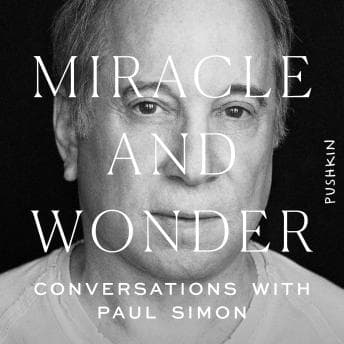

I was grading sophomore essays on The Great Gatsby at 11:47 PM—my third cup of coffee going cold beside me, red pen bleeding across another paper that confused Nick Carraway with Jay Gatsby—when Paul Simon started talking about how he wrote 'The Sound of Silence' as a twenty-one-year-old kid in his bathroom. The bathroom. Because the tiles gave him good reverb.
I set down my pen. The essays could wait.
What Hemingway Would've Called This
This isn't an audiobook in any traditional sense. It's closer to sitting in on a conversation you were never supposed to hear—thirty hours of tape condensed into five, with all the background noise left in. You can hear ice cubes. Chairs creaking. The ambient hum of Paul Simon's backyard studio. That rawness is the whole point.
Malcolm Gladwell and Bruce Headlam don't interview Simon so much as they orbit him, occasionally nudging the conversation toward a song or a memory, then letting him wander. When Simon breaks down 'The Boxer'—explaining how that famous "lie-la-lie" chorus emerged because he simply couldn't find words worthy of the melody—you understand something about songwriting that no biography could teach you. Just a man thinking out loud about his own genius, which sounds insufferable but somehow isn't.
The archival audio woven throughout transforms this from conversation to experience. You're not hearing about 'Graceland'; you're hearing studio takes, Simon noodling on guitar, fragments of songs that almost existed. It's like reading a novel where the author occasionally stops to perform the scenes live.
The Gladwell Problem (And Why It's Not Really a Problem)
Look, I've assigned Gladwell to my students. I know his rhythms—the anecdote, the pivot, the social science study that reframes everything. Some listeners found his presence excessive here, and I get it. I had a similar reaction to the framing device in Life of Benjamin Franklin—sometimes the narrator's commentary felt like it was getting between me and the subject. There are moments where you want him to stop contextualizing and just let Simon talk.
But here's what those critics miss: Gladwell's interruptions serve the same function as a good teacher's questions. When he brings in Sting to discuss Simon's chord progressions, or Herbie Hancock to explain why certain melodies feel inevitable, he's doing the annotation work. He's the footnotes made audible. (My students would hate this. I love it.)
The balance isn't perfect. Around hour three, there's a stretch where Gladwell's historical tangents feel like they're competing with Simon rather than illuminating him. But then Simon will say something offhand—about his childhood in Queens, about the terror of following up a perfect song—and you forget the structural wobbles entirely.
Why This Only Works as Audio
I've been teaching literature for twenty years, and I've watched the audiobook form evolve from "book read aloud" to something genuinely different. This is the clearest example I've encountered of a work that couldn't exist on the page.
When Simon demonstrates a musical idea—playing a chord, humming a melody, showing how a rhythm shifted between drafts—you hear the creative process in real time. There's a moment where he plays an early version of something, then the final version, and the difference is so subtle and so crucial that describing it in text would be pointless. You have to hear the pause. The pause is punctuation.
There's no narrator, really. Just three people talking, with the occasional celebrity dropping in to offer testimony. It's intimate in a way that feels almost intrusive—like reading someone's marginalia in a library book and realizing you're learning more from the scribbles than the text.
Who Should Clear Their Weekend (And Who Should Skip)
If you need narrative structure—a beginning, middle, end, some kind of arc—this will frustrate you. It meanders. It circles back. It assumes you care about the difference between a major seventh and a dominant seventh chord. Skip it if you want biography; this isn't that.
But if you've ever wondered how songs get made—not the mythology, but the actual messy process—this is a masterclass disguised as a conversation. If you loved 'Graceland' or 'Bridge Over Troubled Water' or even just 'Mrs. Robinson' playing over the end of a movie, you'll find yourself pausing to replay sections.
This reminds me of what Hemingway said about writing: that the dignity of movement of an iceberg is due to only one-eighth of it being above water. Simon shows you the seven-eighths. The decades of craft beneath each three-minute song.
Worth Pausing the Faculty Meeting For
Denise found me the next morning still at the kitchen table, essays unfinished, listening to Simon explain why he spent months on a single bridge section. She asked if I was okay. I told her I'd just witnessed something rare—an artist explaining his work without diminishing its mystery.
The Earphones Award and Audies nomination make sense. This is what audio biography should be: not a book adapted to sound, but a work that uses sound as its primary language. At five hours, it's the length of a good road trip, though I'd recommend focused listening. This isn't background material.
Forty-seven podcast listeners will get this reference: it's the audio equivalent of a really good close reading. The kind where you finish and immediately want to start over, because now you know what to listen for.





![Steve Jobs [unabridged audiobook] audiobook cover](/_next/image?url=https%3A%2F%2Fcovers.audiobooks.com%2Fimages%2Fcovers%2Ffull%2F9788499923406.jpg&w=1920&q=75)