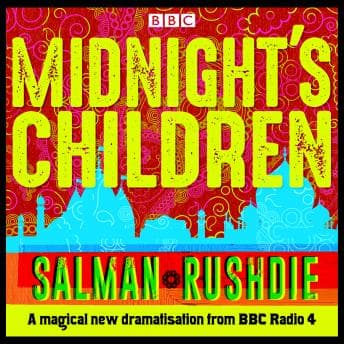

BBC Radio drama is basically D&D for people who read literary fiction instead of rolling dice. Full cast, sound effects, everyone committed to their character—and this adaptation of Rushdie's magnum opus absolutely understands the assignment.
I started this at 2 AM because my thesis wasn't writing itself anyway. (It never does.) Five hours later, I'd experienced three generations of the Sinai family, the Partition of India, and enough magical realism to make me question whether Sanderson invented the concept of a hard magic system or just codified what Rushdie was already doing with telepathic midnight children.
The World-Building Hits Different When You Hear It
Look, I've tried reading Midnight's Children twice. Both times I bounced off it around page 150, overwhelmed by the sheer density of Rushdie's prose. The BBC dramatisation fixes this problem in a way I didn't expect: by stripping the novel down to its bones and letting multiple voices carry the weight.
Nikesh Patel as Saleem threads the needle between unreliable narrator and genuine emotional anchor. His delivery has this quality—part confession, part fever dream—that makes you believe a man could genuinely be "handcuffed to history." When he describes the perforated sheet scene with his grandfather, there's this reverence in his voice that made me stop doomscrolling on my phone and actually pay attention.
Meera Syal brings the kind of energy that makes family matriarchs feel both terrifying and essential. Her scenes crackle with an authority that reminded me of every auntie who's ever told me I should eat more.
Magic System? More Like Historical Entanglement
Okay, hear me out. Rushdie's midnight children—all 1,001 kids born in that first hour of Indian independence, each with supernatural gifts—this is basically a soft magic system wrapped in postcolonial allegory. Saleem can telepathically connect with the others. Some can time travel. One kid literally has the power to step into mirrors.
The dramatisation handles this beautifully through sound design. When Saleem "tunes in" to the other children, there's this layered audio effect—whispers overlapping, fragments of conversation from across the subcontinent—that genuinely gave me chills. It's the kind of production choice that justifies the full-cast format entirely.
(My D&D group would absolutely try to build a campaign around this premise. "Roll for telepathic conference call with 500 other chosen ones.")
What Gets Lost in Translation
At under five hours, this is an aggressive compression of an 800-page novel. Some of the digressions that make Rushdie's prose so distinctive—the tangents, the nested stories, the way he'll spend three pages on a single moment—those are necessarily trimmed. If you're coming to this as your first encounter with the story, you're getting the skeleton rather than the full body.
That's not a complaint, exactly. It's a trade-off. The dramatisation moves with purpose, which the novel sometimes doesn't. But I found myself wanting to pause and let certain moments breathe longer than the adaptation allows.
The Salman Rushdie interview included at the end is a nice bonus—hearing him discuss the Booker of Bookers win and what the novel meant during its writing adds context that enriched my understanding. Worth the extra fifteen minutes.
Who Should Press Play (And Who Should Read Instead)
This is perfect for: literary fiction fans who've bounced off the novel, history nerds curious about Partition, anyone who appreciates BBC production values, and people who want Sanderson-level world-building in a completely different genre.
Skip if: you want the complete unabridged experience (read the book), you're looking for background listening (this requires attention), or you need trigger warnings for violence, abuse, and sexual content—all present, though handled with radio drama discretion.
Worth Neglecting Your Thesis For
I finished this as the sun came up, thesis document still blank, and I regret nothing. That same sense of time-bending immersion hit me with The Midnight Library—different genre entirely, but equally impossible to pause once you're in. The magic system is chef's kiss—even if Rushdie would probably hate me calling it that. This is Sanderson-level world-building applied to twentieth-century Indian history, performed by a cast that clearly understood they were adapting something that won the Booker Prize three separate times.
Yes, it's an abridgement. Yes, you're missing things. But as an entry point into one of the most celebrated novels in English? As a way to finally understand what everyone's been talking about for forty years? This delivers.
Now if you'll excuse me, I have a thesis to continue ignoring.