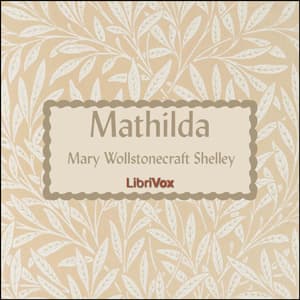

I was grading a stack of sophomore essays on Frankenstein—mostly plagiarized from SparkNotes, naturally—when I decided I needed a break from the Creature. So I switched over to Mathilda.
(Yes, I know. Taking a break from Mary Shelley by listening to more Mary Shelley is peak English teacher behavior. I can't help myself.)
Here's the thing about Mathilda that gets me every time: it was suppressed. Not by the government, but by Mary's own father, William Godwin. The guy was a radical philosopher, basically the punk rock dad of the 18th century, and even he read this manuscript and said, "Whoa, Mary. Too far." He locked it in a drawer. It didn't see the light of day until 1959.
1959!
Listening to it now, walking along Lake Michigan while the wind tries to rip my headphones off, you can kind of see why he panicked. But also, you can see why it's brilliant.
The "Too Much" Factor
Let's be real for a second. This book is A Lot.
If you're looking for the sci-fi horror of Frankenstein, you're in the wrong place. This is Gothic with a capital G—pure, unfiltered mood. The plot is essentially: a father confesses an incestuous love for his daughter (Mathilda), he kills himself (sort of—it's complicated), and then she spends the rest of the book staging a very long, very poetic death from grief.
My students would hate this. They'd say, "Mr. Williams, nothing happens. She just cries in the woods for three hours."
And they wouldn't be wrong. It drags. There are moments where the introspection is so dense I found myself zoning out, watching a seagull fight a pigeon over a french fry, and realizing I'd missed five minutes of lamentation. But that's the point. It's not an action movie; it's a psychological portrait of trauma. It's Mary Shelley working through her own messy, tragic life—lost children, a complicated husband, a mother she never knew—and bleeding it onto the page.
Narrating the Unspeakable
Narrating a book that is 90% internal monologue and weeping is a trap. Most narrators would chew the scenery so hard they'd break a tooth. They'd go full soap opera.
Cori Samuel doesn't do that. Thank god.
Her delivery is incredibly controlled. She has this clear, crisp British tone that grounds the hysteria. She brings that same precision to Black Beauty, where the restraint works beautifully for a very different kind of story. When Mathilda is losing her mind with grief, Samuel keeps the narration steady, almost eerily calm, which makes the emotional breaks hit harder. She understands that the text is already screaming, so the voice doesn't need to.
There's a specific rhythm to Shelley's prose—long, cascading sentences full of semicolons—and Samuel rides that rhythm perfectly. She pauses where the breath should be. She respects the architecture of the sentences. (I tell my students that punctuation is sheet music for the voice; Samuel is a virtuoso player here.)
Why We Still Bother
Look, is this going to be your new favorite beach read? No. Absolutely not. It's heavy. It's uncomfortable. The "father loving the daughter" plotline is... well, it's exactly as icky as it sounds, even if it's handled with 19th-century restraint.
But it's fascinating. It's a missing link in the Romantic canon. Listening to it, you get a glimpse of the darkness Mary Shelley was carrying around while everyone else was busy praising her husband Percy.
I finished the audiobook right as I got back to my apartment. My wife, Denise, asked how the walk was. I told her I just spent four hours inside the head of a suicidal woman fleeing her father's dark desires. She just handed me a glass of wine and went back to watching The Great British Bake Off.
Who should listen: If you love the Romantics, or if you just want to know what was too scandalous for the 1820s, give this a listen. Who should skip: Anyone expecting Frankenstein-style plot momentum—this is pure psychological Gothic, not action.
It's short—under four hours—so you can knock it out in an afternoon. Just maybe have a comedy queued up for afterwards. You're gonna need a palate cleanser.