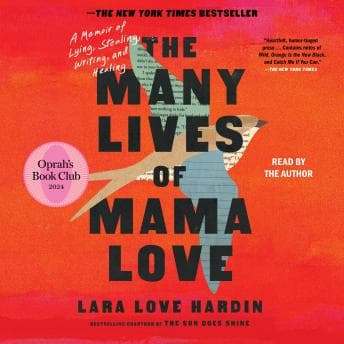

Everyone told me this was an addiction memoir. Oprah picked it. The subtitle literally says "Lying, Stealing, Writing, and Healing." So I went in expecting the standard recovery arc - the fall, the rock bottom, the redemption, the Oprah-approved catharsis. And yes, that's technically what happens. But what nobody warned me about was the part where I'd be sitting in my kitchen at midnight, papers half-graded, laughing out loud at a woman describing the economics of Snickers bars in a county jail.
Let me back up.
The PTA-to-Prison Pipeline Nobody Talks About
Lara Love Hardin was a cul-de-sac mom stealing her neighbors' credit cards to fund a heroin habit. Thirty-two felonies. And here's where my teacher brain kicked in - she describes the social hierarchy of jail as somewhere between a sleepover party and Lord of the Flies, and I've taught Lord of the Flies enough times to know she's not exaggerating. The furniture-made-from-tampon-boxes detail? That's the kind of specific, absurd reality you can't make up, and it hits harder than any abstract reflection on "the system" ever could.
What makes this memoir work is that Hardin doesn't sanitize herself. She was a liar. A thief. She hurt people she loved. And she tells you this without the coy distance some memoirists use to protect themselves. When she earns the nickname "Mama Love" inside - becoming a kind of den mother to women the world has written off - you believe it because she's already shown you the version of herself that was capable of writing bad checks on her neighbor's account without flinching.
This reminds me of what Hemingway said about writing - that all you have to do is write one true sentence. Hardin writes a lot of true sentences, and some of them are ugly.
When the Author IS the Narrator (and It Actually Works)
I'll be honest - author-narrated memoirs make me nervous. I've listened to too many where the writer clearly has no business behind a microphone. But Hardin narrating her own story is the right call here. There's a rawness to her delivery that a professional narrator would've smoothed over, and that roughness IS the book. You hear her voice catch in places. You hear the difference between Lara-telling-a-funny-jail-story and Lara-talking-about-her-kids, and that shift doesn't feel performed. It feels like someone sitting across from you at a kitchen table who's decided to stop pretending.
The narrator understands that pause is punctuation. When she gets to the shame - and this book is really about shame more than addiction - she doesn't rush through it. She lets those moments breathe. At 1.0x (because the author chose those words), the nine hours feel honest. Not padded, not hurried.
Now - some listeners found the early chapters frustrating. I get it. Watching someone make terrible decisions when you can see the consequences coming is its own kind of torture. A few people wanted more about Hardin's childhood, what led to the addiction in the first place. That's a fair criticism. The memoir starts in media res and mostly stays in the present action, which means you're sometimes filling in psychological gaps yourself. But I'd argue that's part of the point. Hardin isn't interested in offering you a neat origin story. She's interested in showing you who she was, who she became, and the grotesque distance between the two.
Ghostwriting as Second Life
The back half of the book - where Hardin reinvents herself as a ghostwriter, legally adopting other people's stories for a living - is where the literary nerd in me sat up. There's something deeply weird and wonderful about a woman who stole identities through credit cards now "stealing" identities through prose, except this time everyone's consenting. She meets Oprah. She meditates with the Dalai Lama. And she's still on probation. The irony isn't lost on her, and it shouldn't be lost on you.
Her line about shame being worse than heroin - that there's no way to detox from it - that's the sentence I keep turning over. Twenty years of watching teenagers, I've seen shame do things to kids that nothing else can. Hardin puts language to something I've always known but couldn't articulate to my students. Ross Gay does something similar in Book of Delights — finding precise, almost embarrassingly honest language for feelings most writers just wave at from a safe distance.
My students would hate parts of this. I love it.
Who Needs This in Their Ears
If you loved Mary Karr's The Liar's Club, this is its spiritual successor - less literary pyrotechnics, more raw confession. If you're drawn to memoirs where the narrator doesn't ask for your forgiveness but earns something harder (your understanding), this is worth your time. Skip it if you need backstory and psychological explanation upfront - Hardin drops you into the chaos and trusts you to keep up.
Worth Pausing the Faculty Meeting For
Denise asked me why I was still up at 1 AM on a Wednesday with ungraded essays everywhere. I told her I was listening to a woman explain how she went from soccer mom to inmate S32179 to ghostwriting for people who get to have dinner with Desmond Tutu. She said, "That sounds made up." It does. It isn't. And that's why we still read - or listen to - the hard stories. The prose deserves to be savored, even when what it's describing makes you wince.