
I was standing at the stove at 8:15 AM making pancakes for the kids, still in my scrubs, one earbud in, when the feral child Alice first appeared out of the Olympic forest in this book. I put down the spatula. Carlos gave me a look. I mouthed "just give me a minute" and stood there like an idiot holding a mixing bowl while Suzanne Toren described this silent, terrified little girl emerging from old growth trees. That opening image hooked me - a child who can't speak, won't make eye contact, communicates with animals but not people. As someone who's worked pediatric trauma cases, that premise hit me somewhere between professional curiosity and gut-level dread.
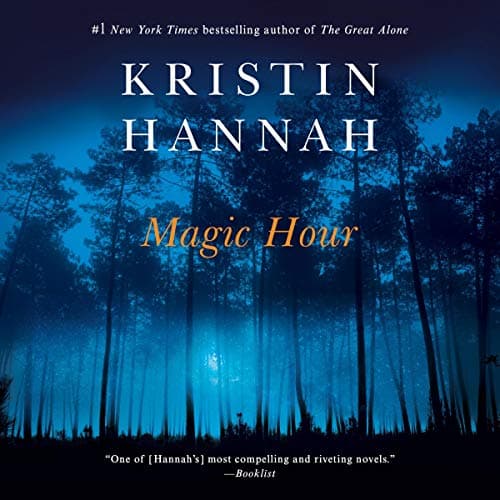
So here's the thing about Magic Hour. Kristin Hannah built this story around a child psychiatrist, Dr. Julia Cates, who's fled a career-ending scandal in Los Angeles and retreated to her tiny hometown of Rain Valley, Washington. Her estranged sister Ellie is the local police chief. A wild child appears. Julia tries to reach her. The town rallies. The sisters reconnect. On paper, it's almost too neat. In execution - at least for the first nine or ten hours - it's genuinely absorbing.
When the Medicine Doesn't Make Me Yell at My Dashboard
I was bracing myself. I always brace myself when fiction involves a psychiatrist treating a child. But Hannah did her homework on selective mutism and the psychological effects of extreme isolation on child development. Julia's therapeutic approach - the patience, the use of play, the incremental trust-building - felt real enough that I wasn't screaming corrections into my steering wheel at 7 AM. That's a compliment. Alice's progression from feral silence to tentative connection follows a believable arc, and Hannah doesn't rush it for the first two-thirds of the book. She lets the small moments land: Alice touching Julia's hair for the first time, Alice learning the word "mine," Alice's terror at being indoors. Those details felt researched, not invented.
The sister dynamic between Julia and Ellie also works. Julia is the polished, educated one who left. Ellie is the one who stayed, married young, divorced, became the law in a town small enough to know everyone's business. Their resentment is specific and earned - Ellie resents Julia's escape, Julia resents Ellie's resentment. It's the kind of eldest-daughter/younger-sibling friction I know in my bones. (My mom would love this. She still thinks I should've been a doctor, and she'd absolutely see herself in their mother.)
The Narrator Problem Nobody Can Agree On
Suzanne Toren. Look, I need to be honest here. Her reading voice - the actual prose narration - is elegant. Her narration on Birds Now and Then and The Bird Primeval has that same polished quality - lovely when she's in straight narration mode, which tells me the issue is really the character differentiation, not her instrument. She has this measured, warm quality that suits the Pacific Northwest atmosphere, the rain and the forest and the quiet. But her character voices? Julia and Ellie both sound like they're 65 and hosting a fundraiser luncheon. These are supposed to be women in their thirties. George, the love interest, comes across like he's doing a Bela Lugosi impression at a dinner theater. I yelled at my dashboard during this one. Not about medicine for once - about why a thirtysomething small-town cop sounds like she's narrating a BBC documentary on garden parties.
It's distracting enough that I'd knock the audio experience down a peg, but not so bad I'd say skip the audiobook entirely. Once you settle in - maybe by hour three - your brain adjusts. Sort of. You stop hearing "pretentious matron" and start hearing the story underneath. Sort of.
Where It Loses the Thread
Here's where my initial enthusiasm started to cool. The back half of the book shifts from Alice's rehabilitation to a custody battle and the mystery of who Alice actually is. And it's... predictable. The revelations about Alice's origins aren't shocking if you've been paying attention. The courtroom-adjacent scenes feel rushed compared to the careful, patient therapy sequences that made the first half so good. Hannah spent hours building this delicate trust between Julia and Alice, then wraps the legal and mystery elements in what feels like forty-five minutes. The ending wants to be triumphant, and emotionally it mostly gets there, but structurally it's lopsided.
Also - and this is minor but it bugged me - the romance subplot between Julia and a local guy feels obligatory. Like someone told Hannah every book needs a love story. It's fine. It's just... there. Taking up space that could've gone to Alice.
Carlos asked why I was crying in the car during the last chapter. I blamed allergies. But those tears were earned by Alice's story, not the tidy resolution. The image of a child learning to trust, learning language, learning that "home" is a place and not just a word - that's the real power here. The plot mechanics around it are just adequate.
Night Shift Prescription
If you love Kristin Hannah's emotional playbook - the estranged family members, the Pacific Northwest setting, the slow rebuild of broken relationships - this is solid mid-tier Hannah. It's not The Nightingale and it's not The Great Alone, but it's better than her lighter stuff. I had the same mid-tier-but-worth-it feeling with The Women, where Hannah's emotional machinery is working hard even when the structure isn't quite keeping up. Perfect for that post-shift decompression when you want something that'll make you feel things without requiring you to track seventeen plot threads on four hours of sleep.
The soft music breaks between sections are a nice touch. Gentle transitions that let you breathe. At 14 and a half hours, it's a commitment, and honestly could've been trimmed by two hours in the back half without losing anything essential.
Who should listen: Anyone who works with kids or has a soft spot for found-family stories - especially if you already like Hannah's brand of emotional drama. Who should skip: If you need tight plotting all the way through, or if narrator voice consistency is a dealbreaker, this one will test your patience.
Night shift approved - with the caveat that you'll need to power through Toren's character voices to get to the good stuff underneath.