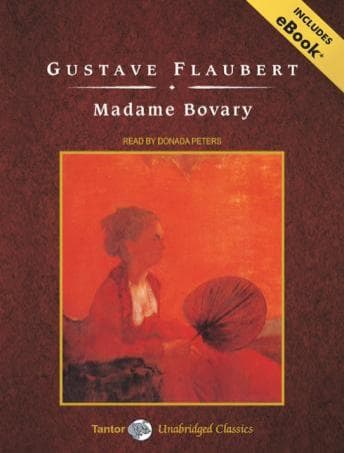

I'm going to say something that will make every literature professor I've ever had wince: I used to teach Madame Bovary wrong.
Not the analysis — I had that down. The irony, the free indirect discourse, Flaubert's obsessive mot juste. I could lecture on all of it. But I was teaching it as a cautionary tale about a foolish woman, when really it's a scalpel taken to the entire machinery of desire — every character's desire, including the reader's. I didn't fully understand that until Donada Peters read it into my ears at 11 PM on a Tuesday while I was pretending to grade sophomore essays on The Great Gatsby.
The Woman Who Wanted Too Much (And the Author Who Understood Why)
Here's what surprised me about coming back to this book in audio form: I'd forgotten how funny it is. Not laugh-out-loud funny. Funny the way your most cutting friend is funny — the one who describes someone's wedding as "aggressively beige" and you feel terrible for laughing. Flaubert does this thing where he'll give you Emma's intoxicating romantic vision — the candlelight, the whispered promises, the swelling orchestral feeling — and then, without any editorial comment, he'll cut to Charles clipping his toenails or slurping soup. The juxtaposition is devastating. And Peters gets it. She doesn't wink at the comedy. She plays Emma's fantasy straight, which makes the deflation land harder.
What Peters does exceptionally well is Emma's yearning. There's this quality in her voice during Emma's early marriage — before the affairs, before the spending spiral — where you can hear the walls closing in. It's not melodrama. It's quieter than that. A flatness that creeps into her reading of domestic scenes, like Emma's own boredom is infecting the prose itself. When Emma finally meets Rodolphe at the agricultural fair and Flaubert cross-cuts between his seduction and a politician droning about livestock prizes, Peters shifts registers so smoothly that the satire becomes almost physical. You feel the absurdity in your chest.
The Death Scene Problem (And Why Flaubert Was Right)
Let's talk about that death scene, because some listeners apparently bailed before the end, and I get it — I do. It goes on. And on. Pages and pages of clinical, almost medical detail. But this is Flaubert being Flaubert at his most ruthless. He spent years writing this novel, agonizing over every syllable, and he chose to make Emma's romantic heroine exit anything but romantic. No soft-focus fadeout. No beautiful last words. Just the ugly, animal reality of what happens to a human body. It's his final refusal to give Emma — or us — the sentimental ending she spent her whole life chasing. That same unflinching commitment to brutal physicality is something I found in Blood Meridian, though McCarthy takes it even further into the abyss.
Peters commits to it. She doesn't rush through the ugliness or soften it, and honestly, around hour ten, sitting in bed with Denise already asleep beside me, I found myself holding my breath during those last passages. Not because they were pleasant. Because they were true.
Now — and I want to be honest here — the pacing does drag in the middle sections. There's a stretch where Flaubert catalogs provincial life with the thoroughness of a census taker, and Peters' measured pace doesn't help speed things along. Some listeners have called her narration "leaden," and I wouldn't go that far, but I'll say this: if you're someone who listens at 1.5x or 2x (you monsters), this might test your patience even at those speeds. The prose deserves to be savored, but some passages are harder to savor than others. That's the book, not Peters.
One legitimate gripe: the chapter navigation is apparently a mess for some listeners. I didn't have major issues, but I can see how losing your place in an eleven-and-a-half-hour novel with long descriptive passages would be genuinely maddening. This is a production issue that shouldn't exist for an AudioFile Golden Voice narrator working on one of the most important novels ever written. Someone at the publisher dropped the ball.
Who Gets an A, Who Gets Excused
If you loved Anna Karenina, this is its spiritual ancestor — though Flaubert is colder than Tolstoy, more interested in dissecting than empathizing. If you've read the novel before and want to experience it fresh, Peters' interpretation of Emma will show you things the page didn't. She finds the humanity in a character Flaubert deliberately made difficult to like, and that's no small feat.
Skip this version if you need tight chapter breaks, if Flaubert's glacial pacing frustrates you on the page (it won't improve in audio), or if you're looking for background listening. This demands your full attention. It's the kind of book where a single sentence can reframe everything that came before, and if you miss it while scrolling your phone, you've missed the point.
My students would hate this. I love it.
Worth Pausing the Faculty Meeting For
This is why we still read the classics — not because they're Important with a capital I, but because a French perfectionist writing 170 years ago understood the gap between the life we imagine and the life we get better than any Instagram caption ever will. Peters' narration isn't flashy. It doesn't need to be. The narrator understands that pause is punctuation, and in a novel built on the distance between expectation and reality, every silence counts.