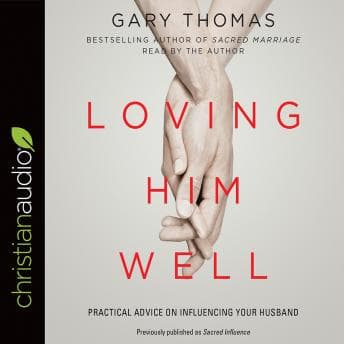

Jenny handed me this one. Just handed me her phone with the Audible page open, said "Listen to this before you give me one more piece of unsolicited feedback about how I load the dishwasher." Fair enough.
So there I was, Sunday morning, doing meal prep for the week - chicken thighs marinating, rice in the cooker - listening to Gary Thomas explain to women how to influence their husbands. A book not written for me, about me. That's a specific kind of humbling.
When a Marriage Book Actually Knows What a Marriage Looks Like
Bottom line: This is a solid, biblically grounded book for Christian wives who want practical frameworks for navigating a difficult or merely stagnant marriage. It's not revolutionary. But it's honest in ways most marriage books aren't, and Thomas earns credibility by not pretending every husband is one conversation away from transformation.
What surprised me - and I genuinely didn't expect this - is that Thomas doesn't sugarcoat the reality that some husbands are just... hard to live with. He distinguishes between marriages that need a tune-up and marriages where a wife is dealing with genuine neglect or emotional absence. That distinction matters. Most books in this space treat every marriage like it's the same problem at different volumes. Thomas actually segments his audience, which is something I tell my startup clients to do and most marriage authors apparently never learned. The one other marriage book I've reviewed that attempts any real audience segmentation is After the Affair, which at least acknowledges that a marriage rebuilding from betrayal is a categorically different problem than a marriage that just went quiet.
He draws on neuroscience research about how men process emotional information differently - not as an excuse, but as operational intelligence. It's the difference between "men are just like that" and "here's why he shuts down when you raise something emotional at 10 PM, and here's what might work better." That's useful. That's actionable. This is what my parents did instinctively. Now it has a TED talk.
The 8-Hour Question
Here's my tension with this book: it's 8 hours and 6 minutes. The core insights - go to God first for validation instead of expecting your husband to fill every emotional need, understand the difference between influence and control, recognize that some men respond to respect before they can hear a request - those land in maybe the first three hours. The remaining five hours are variations, illustrations, and stories from the dozens of wives Thomas interviewed.
Now, are those stories valuable? Some of them, genuinely yes. There's a section where Thomas talks about a wife who realized she'd been using contempt as a weapon disguised as "just being honest," and the specificity of that example hit harder than the principle itself. But other stories blur together. By hour six I was back at 2.0x and still felt like I was getting diminishing returns.
The key takeaway is worth the listen. The other 7 hours? Not so much. But that ratio is actually better than most books in this category, so credit where it's due.
Thomas Reading Thomas
Gary Thomas narrates his own book, and honestly? It works here in a way that author-narration often doesn't. He's not doing vocal gymnastics. He sounds like a pastor who's had a thousand of these conversations - calm, measured, occasionally wry. There's a warmth to his delivery that a hired narrator might not have found, because he wrote these words from decades of actual ministry. You can hear the difference between someone reading advice and someone who's sat across from couples in crisis.
That said, the pacing is pastoral. Slow. Reflective. If you're used to business audiobooks with tight editing and punchy delivery, this will feel like wading through honey. 1.25x minimum. I did 1.75x and it was fine.
Who Gets the Most Out of This
Christian wives in intact marriages that feel stuck or one-sided. That's the bullseye. If you're not coming from a faith perspective, about 40% of this book won't connect - the biblical framework isn't decorative, it's structural. Thomas builds his entire argument on the idea that a wife's primary source of worth and security should be God, not her husband, and everything else flows from there.
If you're a husband (like me, ambushed by your wife's Audible recommendation), it's actually worth listening to as a mirror. Uncomfortable mirror. The kind where you go "oh, she probably highlighted that part" even though it's an audiobook and you can't highlight audiobooks. You know what I mean.
Skip if you're looking for a mutual-accountability marriage framework. This is specifically one-directional - wives influencing husbands - and Thomas is upfront about that. He's written other books that address the other side.
The Dry Cleaner's Son's Take
My mom influenced my dad for 35 years without a single book or framework. She did it through presence, through showing up at 5 AM to open the shop, through quiet persistence that made my dad want to be better because she already was. Thomas would probably call that "leading through respect and consistency." My mom would call it Tuesday.
This book packages real wisdom into a format that will help some women. It's too long, it's occasionally repetitive, and it assumes a specific theological worldview. But within those parameters, it's genuine. Thomas isn't selling a fantasy. He's offering a strategy. Jenny would say I'm being harsh. Jenny is right. But she'd also say this book said some things she needed to hear, and that's worth something.