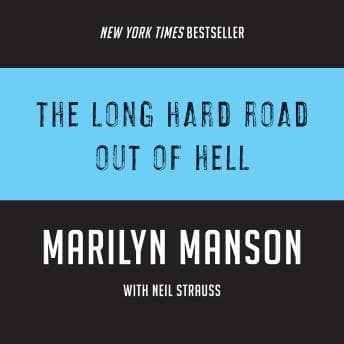

Look, I'm going to be honest: I have no business reviewing this book. I'm a high school English teacher who spends his evenings with George Eliot and his weekends with Dostoyevsky. Marilyn Manson's memoir is about as far from my wheelhouse as you can get without leaving the atmosphere. And yet here I am, two days after finishing it, still thinking about it while Denise gives me that look — the one that says "you're not listening to me, you're composing something in your head again."
She's right. I was thinking about Dante.
The Inferno Framework Is Not a Gimmick
Here's what surprised me. Neil Strauss and Manson structured this thing after Dante's Inferno, and it's not just a cute marketing hook slapped on the cover. The descent is real — you start with young Brian Warner at Heritage Christian School in Canton, Ohio, getting terrorized by kids and teachers alike, and you spiral downward through increasingly depraved backstage scenes, drug binges, and psychological warfare that would make the circles of Hell look organized. The Christian school chapters hit different when you teach at an institution yourself. That kid being told he'd go to Hell for listening to secular music, being shown propaganda films about the Rapture until he couldn't sleep — I've seen what fear-based education does to teenagers. I see it every semester. Manson just took it further than anyone I've ever met.
What Strauss does — and this is why he's one of the best ghostwriters working — is let Manson's voice dominate while quietly imposing a literary architecture underneath. You can feel the chapters getting darker, more chaotic, less tethered to conventional morality, and then there's this slow climb back toward something like self-awareness. It's not redemption. Manson would hate that word. But it's structure, and structure matters even when the content is trying to burn the house down.
James Patrick Cronin Does the Impossible
Here's the thing about narrating a memoir for someone as distinctive as Marilyn Manson: you can't do the voice. You shouldn't try. Cronin doesn't. Instead he finds this dry, almost detached delivery that somehow captures Manson's particular brand of intelligence — the guy who wants you to be horrified but also wants you to notice how well he constructed the sentence that horrified you. Cronin reads the grotesque backstage stories with the same measured calm as the childhood trauma sections, and that tonal consistency is actually the right call. It mirrors how Manson writes about his own life: everything presented at the same emotional temperature, which makes the truly disturbing moments land harder because there's no melodramatic shift to warn you.
The audio quality is clean — no production complaints, no weird volume drops. At nine hours, it's a commitment but not a marathon. I listened to most of it during late-night grading sessions (sophomore essays on The Great Gatsby — the irony of toggling between Fitzgerald's restrained prose and Manson describing things I can't repeat on this website was not lost on me).
What the Author Is Really Saying
Let's talk about what the author is really saying. Because underneath the shock — and there is plenty of shock, content warnings for basically everything — this is a book about identity construction. Brian Warner from Ohio deliberately, methodically built Marilyn Manson as a character, a provocation, a mirror held up to American hypocrisy. And the book itself is part of that construction. You're never quite sure what's true, what's exaggerated, what's performance. That uncertainty is the point.
This reminds me of what Hemingway said about writing — the dignity of movement of an iceberg is due to only one-eighth of it being above water. Manson inverts that principle. He puts everything above water, makes it as visible and ugly and loud as possible, and the hidden part is the vulnerable kid underneath who never stopped being afraid. You catch glimpses of that kid in the strangest places — a throwaway line about wanting his grandfather's approval, a moment where the bravado drops just long enough to see genuine confusion about who he's become.
My students would hate this. I love it. Not because I endorse the behavior — some of it is genuinely reprehensible and Manson barely pretends otherwise — but because it's honest about the machinery of fame in a way most celebrity memoirs aren't. Most rock bios give you the sanitized arc: struggle, success, fall, recovery, wisdom. Manson gives you the mess and leaves you to sort it out. The celebrity memoir as calculated image management is something I kept bumping into in Never Enough: Donald Trump and the Pursuit of Success too — though that one rates considerably lower on the self-awareness scale.
Who This Is For (and Who Should Run)
If you want a cozy listen about a musician finding their truth through the power of song — absolutely not this. Skip it. If you're easily disturbed by graphic sexual content, drug use, and behavior that ranges from questionable to criminal, this is not your book and I respect that boundary completely.
But if you're interested in American culture, identity performance, the relationship between trauma and art, or you just want a rock memoir that's actually written well? Worth your time. Cronin's narration carries it.
The Assignment, Graded
I came in skeptical. I'm leaving impressed — not by the shock value, which gets exhausting by hour seven, but by the craft. Strauss and Manson built something that functions as literature even when it's trying its hardest to be anti-literature. The Dante framework holds. The prose deserves to be savored, even when what it's describing makes you wince. And Cronin's performance is the right narrator for material this volatile — steady hands on a live wire.
Worth pausing the faculty meeting for. (Sorry again, Principal Martinez.)





![Steve Jobs [unabridged audiobook] audiobook cover](/_next/image?url=https%3A%2F%2Fcovers.audiobooks.com%2Fimages%2Fcovers%2Ffull%2F9788499923406.jpg&w=1920&q=75)