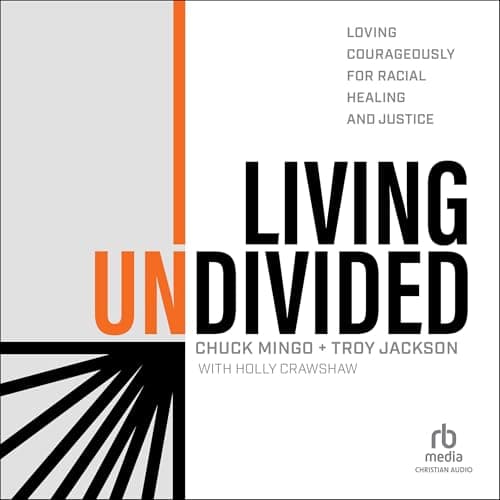

"We've been more focused on order than justice." That line hit me somewhere around the fifteen-minute mark, and I was grading sophomore essays on Their Eyes Were Watching God at 11 PM with my reading glasses sliding down my nose. I put the red pen down. Didn't pick it up again for a while.
Let me back up. I almost didn't press play on this one. I've been teaching on the South Side of Chicago for twenty years, and I've sat through enough well-meaning diversity workshops to fill a semester. But Living Undivided caught me off guard, mostly because of who's talking and how they're talking.
Two Pastors Narrating Their Own Mess
Chuck Mingo and Troy Jackson read their own book, and that matters here in a way it doesn't always matter. Mingo is a Black pastor who left a corporate career at Procter & Gamble to co-found UNDIVIDED, a racial justice nonprofit. Jackson is a white pastor with a Princeton seminary degree and a PhD in U.S. History. They built something together, and you can hear the texture of that partnership when they trade off narration duties.
Neither of them is a trained voice actor, and it shows in places. Jackson sometimes rushes through historical material that deserves more air — passages about how specific American denominations made specific decisions to segregate in specific decades. Those moments need space, and he occasionally reads them like he's trying to get to the personal story on the other side. Mingo's shifts between autobiography and theological argument can feel a little stiff, like he's moving between two different registers and the gear change isn't always smooth.
But here's what I kept coming back to: the slight roughness is the point. This isn't a polished performance piece. It's two men who've done the actual work of building interracial community, reading words that came from that work. When Mingo gets quiet — and he does get quiet at key moments rather than getting louder — you feel the restraint of someone who's earned the right to yell but chooses not to. Pause is punctuation here, and Mingo's pauses carry weight.
The Historical Receipts
I teach English, not history, but twenty years in a Chicago public school means I've had more conversations about race with sixteen-year-olds than most people have in a lifetime. What strikes me about Living Undivided is that Mingo and Jackson don't skip the homework. Jackson's academic training shows up in how they trace racial division through American Christianity — not in vague terms, but with denominational specifics. They talk about churches as some of the first American institutions to formalize segregation, and they bring documentation.
This reminds me of what Hemingway said about the iceberg theory — what's visible only works because of everything underneath. The personal stories are the visible part of this book. The historical framework is the mass below the waterline. Without it, you'd have two earnest guys sharing feelings. With it, you understand why those feelings exist and why they're not just personal but structural.
At five hours and thirty-six minutes, this is a tight listen. They're not padding. Each chapter ends with practical action steps — not vague calls to "do better" but structured prompts for things like organizing interracial dialogue groups or examining your own church's institutional history. The kind of stuff you could actually bring to a church staff meeting or a book club and use. (My students would probably tolerate this one, which from a room full of juniors is high praise.)
First-Time Caller scratched a similar itch for me — practical, grounded, the kind of listen where you finish a chapter and immediately want to call someone to talk it through.Who Should Grab This (And Who Should Skip It)
Let me be direct. Mingo and Jackson are working from a serious Christian framework — biblical citations, theological arguments, the whole apparatus. If faith-based framing isn't your thing, you'll spend the whole time fighting the container instead of engaging what's inside it. That's not a flaw in the book; it's just a mismatch. Skip it and save yourself the frustration.
But if you're a person of faith who's been sitting in a pew wondering why your church looks the same every Sunday and feeling a low-grade guilt about it — this was written for you, specifically, with your specific discomfort in mind. It's also genuinely useful for church leaders, small group facilitators, or anyone who needs a framework for having hard conversations instead of just having feelings about them.
The brevity works in its favor. You could listen to this on two focused walks, or across a few evenings of grading, and come away with actual language and structure for conversations you've been fumbling through. I've been fumbling through some of those conversations myself — in faculty lounges, at parent conferences, at Thanksgiving dinner with the uncle who brings opinions along with the potato salad.
Red Pen Down, Ears Open
I won't claim this book reinvented how I think about race in America. Two decades on the South Side already did a lot of that work. But it gave me a framework — particularly for talking with colleagues and fellow churchgoers — that I didn't have before. Jackson's historical rigor paired with Mingo's pastoral honesty makes something more useful than either could've built alone. Worth pausing the faculty meeting for. Worth putting down the red pen.