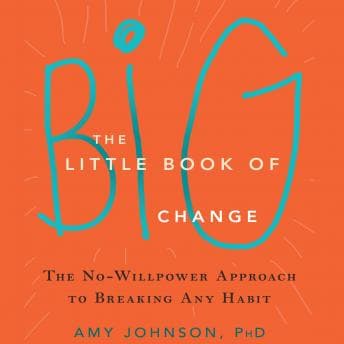

I was making dal makhani at eleven on a Tuesday night — the kind of elaborate, unnecessary cooking my therapist would probably analyze — when Kathleen Mary Carthy's steady voice told me that my habits aren't actually me. And I stood there stirring lentils, thinking: okay, Amy Johnson, you have my attention.
Here's the core premise of The Little Book of Big Change: your bad habits aren't character flaws. They're impersonal brain wiring. Neural circuits that got reinforced through repetition, and they can be un-reinforced. Johnson draws on what she calls a combination of neuroscience and the Three Principles (a psychological framework rooted in the work of Sydney Banks), and she argues that willpower is the wrong tool entirely. You don't fight your urges. You observe them, recognize them as neurological noise, and let them pass. The Untethered Soul takes this exact premise and goes somewhere more spiritually expansive with it — worth reading alongside Johnson if you want to see where the "you are not your thoughts" thread leads when someone really commits to following it all the way down.
When "You Are Not Your Thoughts" Becomes a Therapeutic Mantra
Psychologically, this tracks — to a point. The research actually shows that cognitive defusion (the idea that thoughts are events in the mind, not facts about reality) is a well-supported strategy in ACT and mindfulness-based approaches. Johnson is essentially packaging that insight for a general audience, and she does it with genuine clarity. Her analogy of habits as "brain superhighways" that lose traffic when you stop traveling them? That's accessible and, importantly, accurate in broad strokes.
But here's where I found myself asking: why does Johnson keep restating the same idea in slightly different language, chapter after chapter? At four hours and twenty-six minutes, this is a short listen. And yet it still felt repetitive. By about the halfway mark, I'd internalized the central thesis — your urge is just a feeling, feelings pass, you are the sky and not the weather — and the book kept circling back. One listener described it as "hypnotic-level repeating," and honestly? That's generous. It felt less like reinforcement and more like the book didn't trust me to get it the first three times.
This is a fascinating case study in the tension between simplicity and depth. Johnson has a PhD. She clearly knows the science. But she made a choice to strip almost everything down to its most digestible form, and for listeners who want the why behind the mechanism — which neurons, which pathways, which studies — the book can feel like it's holding back. She almost treats complexity as the enemy, when some of us actually want to understand the machinery.
Kathleen Mary Carthy's Voice Does What Willpower Can't
Carthy narrates with this warm, unhurried steadiness that suits the material perfectly. She sounds like a therapist who genuinely believes what she's telling you — not performative calm, but actual gentle conviction. For a book that asks you to stop fighting yourself and just... notice... her pacing mirrors that philosophy. She doesn't rush through the concepts. She lets ideas land.
No dramatic vocal shifts, no theatrical emphasis. Single narrator, clean audio, no production gimmicks. Which is exactly right for this kind of book. You don't need sound effects when someone is asking you to sit with discomfort. You need a voice that doesn't add to the noise. Carthy delivers that.
My one note: at 1x speed, the combination of her measured delivery and the book's repetitive structure made certain sections drag. I bumped to 1.25x around hour two and it helped considerably. The content became crisper without losing Carthy's warmth.
Who Gets the Most From This (And Who Will Be Frustrated)
If you're someone who's tried the white-knuckle, willpower-based approach to breaking a habit and it hasn't worked — nail-biting, emotional eating, scrolling, whatever — this book offers a genuinely different framework. Johnson's insistence that urges are temporary neurological events, not commands you must obey, is the kind of perspective shift that can actually change behavior. The Three Principles angle won't land for everyone (it leans spiritual in places), but the underlying psychology is sound.
If you're looking for rigorous neuroscience, clinical studies, or strategies beyond "observe and release" — you'll probably feel like Johnson is talking around you rather than to you. And if you've already read any mindfulness-based habit literature (like Judson Brewer's work, for instance), you'll recognize most of these ideas in a less detailed package.
(My therapist would have thoughts about this book. Specifically, she'd probably agree with 70% of it and push back on the implication that all habits dissolve once you stop identifying with them. Some habits have roots that need more than observation. But that's a longer conversation.)
My Clinical Assessment
This is a solid entry-level listen for anyone stuck in the shame-willpower-failure cycle. It won't satisfy the academically curious, and yes, it could've been two hours shorter. But the central insight is legitimate, Carthy's narration is genuinely soothing without being soporific, and at under five hours, the commitment is low. Think of it as a first session with a therapist who has one very good idea — and really, really wants you to hear it.