Nobody warns you that a giggle is the hardest sound to caption.
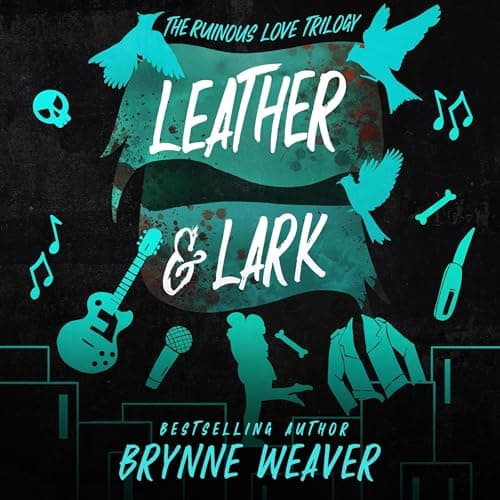
There's no word for it in the text. So when the ebook I keep synced alongside the audio says Lark said something and the narrator adds a little laugh on top, my brain has to decide in real time: is that bit of noise character, performance, or my hearing aids misreading breath? I was walking down Broadway on Capitol Hill, an hour out of the audiologist's office with my high-frequency gain freshly bumped, testing the new settings on Leather & Lark. A duet romance about a contract killer and an indie singer-songwriter turned out to be a good stress test. It exposed both what this production does brilliantly and the one habit that kept pulling me out of it.
An Irish killer, and a songbird with consonants you can trust
I'll start with the good, because there's a lot of it.
Eric Nolan voices Lachlan Kane, who works in a leather studio, wants a quiet life, and botches the wrong job. Nolan plays him controlled and low, and the Irish accent is the main reason the performance works. Listeners keep singling it out, and I understand why from an access angle as well as an aesthetic one. An accent with a strong melodic shape gives you a second channel of information. When his consonants blurred against bus brakes on Pine, the rhythm still told me Lachlan was talking and roughly how annoyed he was. That isn't decoration. For hard-of-hearing listeners, that's speaker identification you can feel.
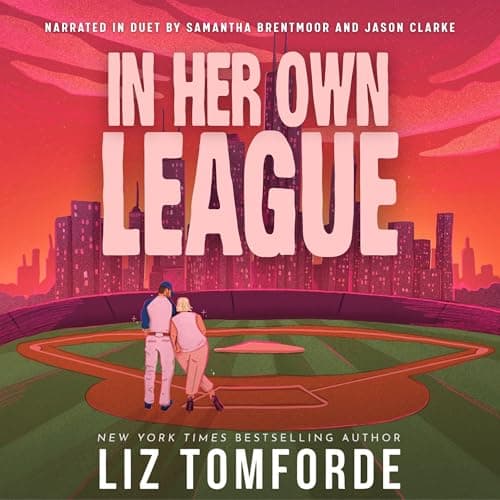
Samantha Brentmoor is the opposite instrument, and that contrast carries the hate-to-love setup. Her delivery for Lark is crisp, quick, sharp on the comic timing. Final consonants land. Sentence ends don't drop into mush, which is the narrator habit I flag most often in publisher audits. I rarely glanced at the text during her chapters, and I can't give a performance much higher praise than that. She also narrates In Her Own League opposite Jason Clarke, and that's where I'd go to find out whether her consonant discipline holds up outside this book.
Then she sings. Lark is a singer-songwriter, so the production commits to it and has Brentmoor actually perform the songs rather than read lyrics flat. I respect the commitment. Pitch carries emotion beautifully through my aids, but sung lyrics are where intelligibility goes to die for a lot of us, so I leaned hard on the text there. Reactions split sharply: one reviewer loved the singing, another skipped it as "cringey." My take is that it's a smart creative choice that needs a text companion to be fully accessible.
About those giggles
Here's my one real grievance, and I'm not the only listener who raised it. Both narrators giggle a lot, and the giggling clusters in three places: the playful flirting, the singing, and the sex scenes. One reviewer described it exactly: only those scenes get performed that way.
Why it bugs me professionally: unscripted vocalizations have no text anchor. Every one of them is a moment where a caption-dependent listener loses sync, and when they pile up in the intimate scenes, those scenes start to sound like a different register from the rest of the book. Everyone online brings up the crawl moment, and it does land. I just wanted the scene to trust its own heat without a laugh track underneath.
It's a texture problem, not a dealbreaker. But it's the kind of directing note that would have tightened the whole production.
Where the fake marriage holds and where the plot runs thin
The marriage-of-convenience bickering is the engine. The deal is that Lark secures Lachlan's freedom if he hunts down a killer, and he has to marry her first. The banter crackles because the two voices genuinely contrast: clipped, bright speed against a slow Irish grumble. The confession scenes are where both narrators drop the comedy and slow down, and those quieter passages got me more than I expected.
The part that rearranged the book for me is Lark's PTSD episode. Until then, you could take her as the glitter-and-sunshine princess Lachlan assumes she is. After it, the brightness reads as armor. Brentmoor's timing in that stretch stops being cute and turns precise and careful. That's performing, not reading.
The weaknesses are in the story, and the complaints are fair. The villain confrontation wraps up too easily. Some listeners found the middle thin and the chemistry less scorching than Butcher & Blackbird. Fans of the first book's couple, Sloane and Rowan, wanted more of them. If that feral edge is what you're after, Butcher & Blackbird is where it lives, though you'll be sampling a different pair of voices, Joe Arden and Lucy Rivers, so test them against your own ears first. Over 12h 15m, I felt the slack. This one is warmer and sillier than its predecessor, and less feral. One listener also didn't like Nolan's voice for Lachlan. I did, but low, controlled male registers are exactly what some ears struggle with, so sample it first.
Sign the prenup, keep the ebook open
If you want a dark rom-com where the audio arguably beats the page, this production earns its credit. That's mostly because of an accent that does real accessibility work and a narrator whose consonants never quit on you.
If you're hard of hearing like me, pair it with the text, especially for the songs and the giggle-heavy scenes. And if you came for book one's intensity, adjust your expectations before the vows, not after.