
This is what my parents did instinctively. Now it has a TED talk.
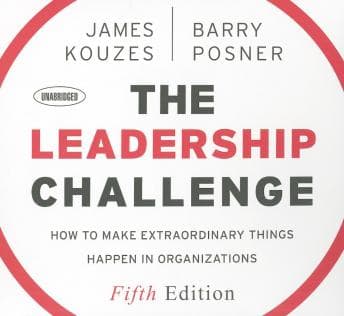
I was reorganizing my home office at midnight - Jenny was asleep, I was procrastinating on a client deck due Monday - when I decided to finally knock out The Leadership Challenge. Ten hours. At 2.0x, that's five. I figured I'd get through it before the sun came up. And honestly? I almost did. But not because it gripped me. Because it's the kind of book that keeps delivering content at a steady, relentless, academic pace that doesn't let you zone out or fully engage.
Five Practices, One Framework, Eight Hours of Padding
Bottom line: Kouzes and Posner's Five Practices of Exemplary Leadership - Model the Way, Inspire a Shared Vision, Challenge the Process, Enable Others to Act, Encourage the Heart - are legitimately useful. They're research-backed, they've held up across editions, and they map cleanly onto what I've seen work at companies from Series A startups to Fortune 500 orgs. The Leadership Practices Inventory (LPI) they developed is actually used in real organizations, not just sold at airport bookstores. That matters.
But here's the thing. The framework itself? You can absorb it in maybe 90 minutes. The remaining 8+ hours are case study after case study after case study. Some land - there's a section on a nurse manager who transformed her unit's culture by literally walking rounds differently, which felt real and specific. Others blur together into a soup of "and then THIS leader also did something extraordinary." By hour six (hour three at my speed), I was playing a mental drinking game every time someone "modeled the way."
The key takeaway is worth the listen. The other 7 hours? Not so much.
When Academics Read Their Own Book (Sort Of)
The narration setup is interesting - Kouzes and Posner handle some sections themselves, with Sean Pratt doing the heavy lifting on the main text. Having the authors pop in adds a certain credibility, like hearing the professor drop into office hours. But neither Kouzes nor Posner is a trained narrator, and you can hear it. Their delivery is earnest but flat - the kind of measured, careful reading you get from someone who's given a thousand keynotes but hasn't spent time in a recording booth learning pacing. Pratt is solid and professional, but the transitions between voices feel a little jarring. You're cruising with Pratt's polished cadence and then suddenly you're in a lecture hall.
Not a dealbreaker. But at 2.0x, the author-narrated sections got a little muddy. I'd recommend 1.5x if you want to catch everything from their portions.
My Parents' Dry Cleaning Business Had All Five Practices
Here's what got me. Reading through these five practices, I kept thinking about my mom and dad. Model the Way? My dad opened the shop first, closed it last, every single day. Inspire a Shared Vision? My mom talked about putting me and my sister through college like it was a business mission statement - everyone who worked there knew the Park family plan. Challenge the Process? They switched from traditional pressing to a faster system in '97 because my dad watched a competitor and said "we can do that better." Enable Others to Act? They trained every employee personally, gave them autonomy on customer interactions. Encourage the Heart? My mom brought homemade kimchi jjigae for the staff every Friday.
None of this required a 360-degree assessment tool or a five-day leadership retreat. And that's both the strength and weakness of this book. The principles are real and true and observable in every good leader from a Koreatown dry cleaner to a Silicon Valley CEO. Adam Grant makes a similar case about fundamental human behaviors in Give and Take, and he manages to do it without 47 redundant case studies. The question is whether you need ten hours to internalize them.
For early-career managers who've never had a framework for what good leadership looks like? Yes. This is a solid foundation. I've seen the LPI used at two different client organizations and it actually shifts behavior when people take it seriously.
For anyone who's been managing people for five-plus years and reads even moderately? Skip to chapter 5, where they get into "Enable Others to Act." That's where the freshest thinking lives, especially around trust and collaboration mechanics. Thank me later.
Who Gets the ROI
New managers, first-time founders, anyone who's been promoted into leadership and is quietly panicking - this earns its listen. The framework gives you vocabulary for things you sense but can't articulate. MBA students will recognize chunks of this from their coursework, which tells you it's foundational.
Seasoned leaders, serial entrepreneurs, anyone who's read more than five leadership books - you'll be nodding along but not learning. And nodding at 2.0x speed gets old fast.
Jenny would say I'm being harsh. Jenny is right. It's a good book. It's just not a great audiobook. The density-to-insight ratio is off for the format. Give me a tight three-hour version of this and I'd bump it a full point.
The Consulting Recommendation
Finally, a leadership framework that earns its reputation through actual longitudinal research rather than one CEO's memoir dressed up as universal truth. But the audio format exposes the book's academic DNA - repetitive, thorough to a fault, padded with examples that serve a textbook better than they serve your commute. Read the summary, listen to the chapters that matter, deploy the LPI with your team. That's where the real value lives.