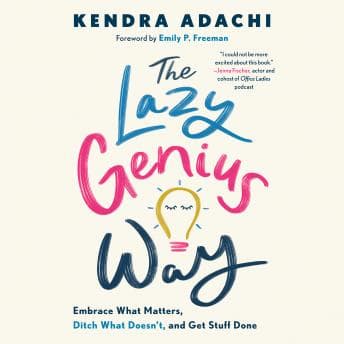

This is basically Marie Kondo but for your entire decision-making architecture.
Let me explain. I picked this up during a week where I was drowning in decision fatigue — not from work stuff (distributed systems have clear debugging frameworks, thank god), but from everything else. Meal planning, whether to RSVP to that wedding in Portland, whether I should switch dentists, whether the fact that I haven't switched dentists means I'm a fundamentally lazy person. You know. Life admin.
I listened to most of this on a Saturday while deep-cleaning the apartment Kevin and I keep saying we'll organize "next weekend." Which, honestly? Perfect pairing. Kendra Adachi's whole thesis clicked while I was literally deciding whether to keep or toss a box of cables I haven't touched since 2019.
The "Decide Once" Principle Is Basically a Cache Layer for Your Brain
Okay so the book lays out thirteen principles, and some of them are genuinely useful mental models. "Decide Once" is the standout — the idea that you make a decision one time and stop relitigating it. Tuesday is taco night. You always buy the same brand of paper towels. You don't agonize over it again. As an engineer, I immediately mapped this to caching. You're reducing computational overhead on low-stakes decisions so you have bandwidth for the ones that actually matter. That framing alone was worth the listen.
"Ask the Magic Question" is another good one — basically, "what can I do now to make [future thing] easier?" It's prep work. It's shifting left on your own life. I've already started applying it to my morning routine (laying out clothes the night before so 5:45 AM Sarah doesn't have to make choices with her three functioning brain cells).
But here's where I have to be honest: not all thirteen principles carry the same weight. Some feel like they could've been a single Instagram carousel. "Start Small" — yeah. I know. "Live in the Season" felt more like a lifestyle blog mantra than a framework. The book is 7 hours, and I think the actual actionable content could fit in about 4. I bumped it to 1.75x for the middle chapters and didn't miss a thing.
The Narration Situation
So here's the thing — Kendra Adachi wrote this book, but Emily P. Freeman narrates most of it (she also wrote the foreword). Freeman is pleasant. Warm. Competent. But there's a noticeable energy gap between her delivery and what you'd expect from someone who built an entire brand around being relatable and slightly chaotic in the best way. It's like watching someone else give your TED talk — technically fine, but missing that specific spark.
The instructional sections work well enough. Freeman has a clear, steady cadence that's good for absorbing principles. But the humor — and there IS humor in the writing — sometimes lands flat because the delivery doesn't quite punch it. I've heard clips of Kendra on her podcast, and she's got this dry, self-deprecating energy that just doesn't fully translate through a different voice. It's not bad narration. It's just... not the narration this particular book deserved.
Who This Is Actually For (And Who Should Skip)
Perfect for: People who feel overwhelmed by productivity culture but also overwhelmed by the anti-productivity "just vibes" crowd. If you've read Atomic Habits and Getting Things Done and felt like both were written for a different species than you, this might be your speed. What a Time to be Alone lands in that same exact pocket — self-help that actually sounds like a human wrote it, for humans who are tired of being optimized at. It's specifically aimed at people (let's be real, mostly women, and the book leans into that audience hard) who feel crushed by the gap between Pinterest-perfect optimization and reality.
Skip for: Anyone who already has a solid personal productivity system. If you've already figured out your own version of "decide once" and "batch your tasks," this will feel redundant. And if you're looking for the kind of rigorous systems-thinking you'd get from a Cal Newport book, this ain't it. The principles are sound but surface-level.
Kevin asked me if I liked it and I said "it's a 3.5 that thinks it's a 4.5" and he said that's the most me sentence I've ever said. Fair.
The ROI Check
The ROI on this audiobook is... moderate. Two or three of the thirteen principles genuinely changed small behaviors for me. The rest I'd already internalized from years of reading productivity content. If you're newer to this space, the return is much higher. If you're a veteran optimizer, you're paying 7 hours for maybe 2 hours of new insight.
I finished this in one long cleaning session plus a Monday morning commute. At 1.75x it's basically a 4-hour listen, which feels right for the content density. Commute-worthy if you're in a season (see, I'm using the language now) where life admin feels impossible and you need permission to stop optimizing everything. Just don't expect it to rewire your brain.